
TUNG OIL
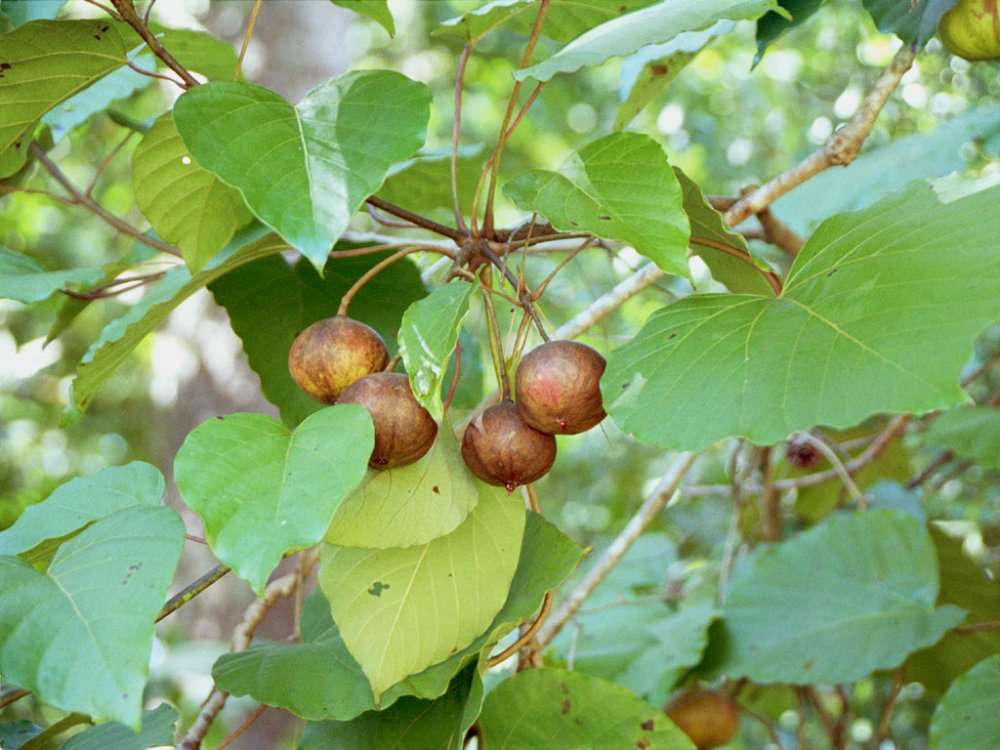
Tung nuts are grown on a tree indigenous to China. The name of the tree is derived from the heart-shape of its leaves, as the Chinese word for heart is "tung". The tung nut tree reaches a height of about 25-feet and will produce approximately 20-25 pounds of nuts per season. The tung nuts are processed to produce a poisonous oil, sometimes called Chinese wood oil, which is sold as an industrial-use vegetable oil. (The Mississippi Press, ?, p. 3-A)
The refined tung nut oil was used extensively in the manufacture of paints, varnishes, enamels, pulp board, and as a waterproofing agent. Technological advances in the paint industry and damage to orchards severely reduced its demand and production until very recent times, when a revival for tung oil was ordained by new environmental regulations. Once again, tung oil is used in the paint and printing industry displacing petroleum distillate compounds which are deemed environmental hazards. (The Mississippi Press, November 24, 1996, p. 4-A)
In 1905, tung nut trees were imported from China and first cultivated in a cemetery at Talahassee, Florida. By 1936, more than half of the 50,000-acres of domestic tung nut trees were growing in south Mississippi. The well-drained, moist, slightly acidic soil of cut-over timberlands in the Gulf coastal plain of South Mississppi made this an ideal region for tung nut tree cultivation. (The Jackson County Times, August 22, 1936) Certain sections of Stone and Harrison Counties were sites of pioneer tung nut cultivation.
TIMELINE
1906
The first Tung Oil tree in Mississippi was planted by Aristede Hopkins in 1906 on Hopkins Boulevard.(The Daily Herald, July 28, 1933, p. 1)
1931
The American Tung Oil Production Corporation of New York through their local representative, Thomas H. Hawkes, is reported to have established an extensive nursery near Carriere, Mississippi for growing tung trees to be planted in 1931 and 1932. The corporation has secured acreage to establish tung tree groves for 6000 acres of trees from the seedlings produced at the Carriere nursery. In addition, Lamont Rowlands (1877-1958), an extensive land owner about 10 miles north of Picayune, Mississippi, is reported to be planting 4000 acres of tung tree seedlings here.(The Daily Herald, January 28, 1931, p. 1)
1933
Biloxi's Anthony V. Ragusin wrote an article on the tung oil industry that was published on February 12, 1933, in the Memphis Commercial Appeal newspaper.(The Daily Herald, February 15, 1933, p. 2)
1934
Lamont Rowlands (1877-1958) of Picayune, Mississippi and a pioneer in the tung oil industry, will head a delegation to Warm Springs, Georgia in November to make an appeal to President Roosevelt to require the Federal Land Bank at New Orleansto make loans to farmers desirous of planting tung oil orchards.(The Daily Herald, October 23, 1934, p. 8)
1935
The Great Southern Hotel at Gulfport, Mississippi was the venue for a meeting held in early April by tung oil growers and promoters.(The Daily Herald, April 5, 1935, p. 1)
1936
Proposed tax on tung oil dropped.(The Daily Herald, June 2, 1936, p. 1)
1938
The Tung Oil Planting and Milling Company, Inc. of New Orleans acquired the old Smith Foundry Building on 14th Street and 32nd Avenue. They planned to convert the structure into a plant to process the ting nut and soy beans.(The Daily Herald, February 2, 1938, p. 1)
1939
Sherwin-Williams announced its development of "Dehydrol" as a substitute for tung oil. The product is made from castor oil.[The Daily Herald, November 17, 1939, p. 2]
1941
In March, the first 10,000-gallon rail tank car of tung oil was shipped from the mill of L.O. Crosby and Sons at Picayune, Pearl River County, Mississippi to a Chicago buyer. It was planned to ship a similar size tank car every ten days. Crosby had acquired 100 tons of tung nuts at $60 per ton and had contracted to purchase 1800 tons of nuts. Tung oil was selling on the New York market for 28 cents per pound.(The Daily Herald, March 11, 1941, p. 7)
1944
American production of tung nuts increased from 9300 tons in 1939 to 9300 tons in 1943 and the value of the product went from 15 cents per pound to 39 cents per pound in this time period. Mississippi led the nation with 78,200 acres of trees; Florida had 28,250 acres; Lousiana-27,900 acres; Georgia-8100 acres; Alabama-3800 acres- and Texas-550 acres.(The Daily Herald, May 31, 1944, p. 4)
1947
In early May, Edward C. Gay of Gulfport, Mississippi was re-elected president of the American Tung Oil Association at its convetion at Pensacola, Florida. Other officers chosen were: Samuel S. Tomlin, vice-pres.-Atlanta, representing the Eastern Section of the tung belt; Charles W. Goodyear Jr.-vice pres,-Bogulsa, Louisiana, representing the western section; and Marshall Ballard Jr.-sec.-treas.-Lumberton, Mississippi. More than 150 growers and millers from six tung producing states were at the gathering.(The Daily Herald, May 3, 1947, p. 1)
It was decided at the May 1947 at the Pensacola gathering of tung oil growers and millers from Alabama, Georgia, Flordia, Mississippi, Louisiana and Texas that the 1948 convention would be held at Gulfport, Mississippi.(The Daily Herald, may 5, 1947, p.1)
1948
First Mississippi produced tung oil began to flow in late January at the American Tung Oil Mill at the Landon Community situated four miles north of Gulfport and near US Highway No. 49. The plant processed nuts from groves in George, Greene, Harrison, Jackson, Hancock, Harrison, Perry, and Stone Counties in Mississippi and Mobile and Baldwin Counties in Alabama.(The Daily Herald, January 29, 1948, p. 1 and June 2, 1949, Sec. II, p. 1)
1949
Mississippi produced 43,600 tons of tung nuts valued at $2,834,000-a record harvest.(The Daily Herald, September 5, 1952, p. 17)
1951
Cold weather in mid-March resulted in about half of Louisiana's tung nut crop valued at $1.5 million dollars to have been destroyed. Mississippi's tung nut crop was not seriouly harmed by the chill. The cold snap was the worst to damage the Louisiana tung crop since 1939. Unofficial government estimates predicted that the 1951 tung crop would double the production of 1950 with Mississippi producing 40,000 tons; Louisiana 30,000 tons; and Florida 25,000 tons.(The Daily Herald, march 16, 1951, p. 1)
1952
Plan to recruit workers in the tung harvest.(The Daily Herald, October 4, 1952, p. 7)
1953
Mississippi's tung production in 1953 was estimated to be about 100 per cent of 1952's 60,000 tons. This unusual repeat was attributed to new tung orchards which were planted with better varieiries developed by the new tung laborotory. Pearl River County was the salient locus of the new tung orchards.(The Daily Herald, August 14, 1953, p. 1)
1964
The Tung industry was planning their 31st annual meeting.(The Daily Herald, September 3, 1964, p. 6)
J. Riley Rankin of Poplarville, Mississippi was named Tung Oil Man of the Year.(The Daily Herald, September 25, 1964, p. 9)
REFERENCES:
Mississippi Gulf Coast Yesterday & Today (1699-1939), Federal Writers Project in Mississippi Works Progress Administration, (Gulfport Printing Company: Gulfport-1939), pp. 30-31.
The Daily Herald, “Theo. Bechtel is Rotary speakerTung Oil trees”, December 3, 1930, p. 1.
The Daily Herald, “Plan Tung Oil tree expansion”, January 28, 1931, p. 1.
The Daily Herald, “Tung Oil trees”, May 1, 1931, p. 2.
The Daily Herald, “Show interest in Tung trees”, January 23, 1933, p. 3.
The Daily Herald, “Tung oil article”, Febuary 15, 1933, p. 2.
The Daily Herald, "Will appeal to President", October 23, 1934, p. 8.
The Daily Herald, "Importance of Tung Oil is stressed by U.S. experts", April 5, 1935, p. 1
The Daily Herald, "Tung production sets new record", October 30, 1936, p. 2.
The Daily Herald, “Tung meeting set for Coast”, December 7, 1937, p. 1.
The Daily Herald, "Tung oil group [Tung Oil Planting and Milling Company of NOLA] buy building [in Gulfport]", February 2, 1938, p. 1.
The Daily Herald, “McNeil favored for tung oil experiment”, May 18, 1938, p. 5.
The Daily Herald, “Studying tung oil fields”, December 31, 1938, p. 2.
The Daily Herald, "Large tung oil shipments move from Picayune", March 11, 1941, p. 7.
The Daily Herald, "Tung oil becomes $1,000,000 crop", March 11, 1944, p. 4.
The Daily Herald, “Ed Gay reelected American Tung Oil president”, May 3, 1947, p. 1.
The Daily Herald, “Gulfport to be site of 1948 Tung Oil Convention”, May 5, 1947, p. 1.
The Daily Herald, “6,000 Tung trees reported in [Harrison] County”, September 17, 1947, p. 5.
The Daily Herald, “Wants anti-dumping act invoked against Tung Oil imports", October 27, 1947, p. 1.
The Daily Herald, “New plant produces first Tung Oil in Harrison County”, January 29, 1948, p. 1.
The Daily Herald, “Colmer introduces tung nut measure", February 13, 1948, p. 1.
The Daily Herald, “Tung Group scans 8-point plan”, May 27, 1949, p. 1.
The Daily Herald, “History of tung trees, oil told YMBC address”, June 1, 1949, p. 9.
The Daily Herald, “Landon Tung Mill serves 29,576 acres of Tung trees-Harrison alone has 2420 acres”, June 2, 1949, Sec. II, p. 1.
The Daily Herald, "Louisiana tung crop is heavily damaged", March 16, 1951, p. 1.
The Daily Herald, “Tung Oil import bill introduced by Rep. Colmer", June 12, 1951.
The Daily Herald, "Mississippi is the largest producer of tung nuts", September 5, 1952.
The Daily Herald, "Plan to recruit workers in the tung harvest", October 4, 1952.
The Daily Herald, “Coast delegation [Rep. Colmer (D-Miss) asking Tung oil imports be barred”, March 13, 1953.
The Daily Herald, “Tung crop 80 per cent of last year”, August 14, 1953.The Daily Herald, “Tung support price $52.13”, October 31, 1957.
The Jackson County Times, "Tung Oil to be studied at M'Neil Station", August 22, 1936, p. 1.
The Sun Herald, “Tung Oil pays anew”, November 1, 1998, p. H1.