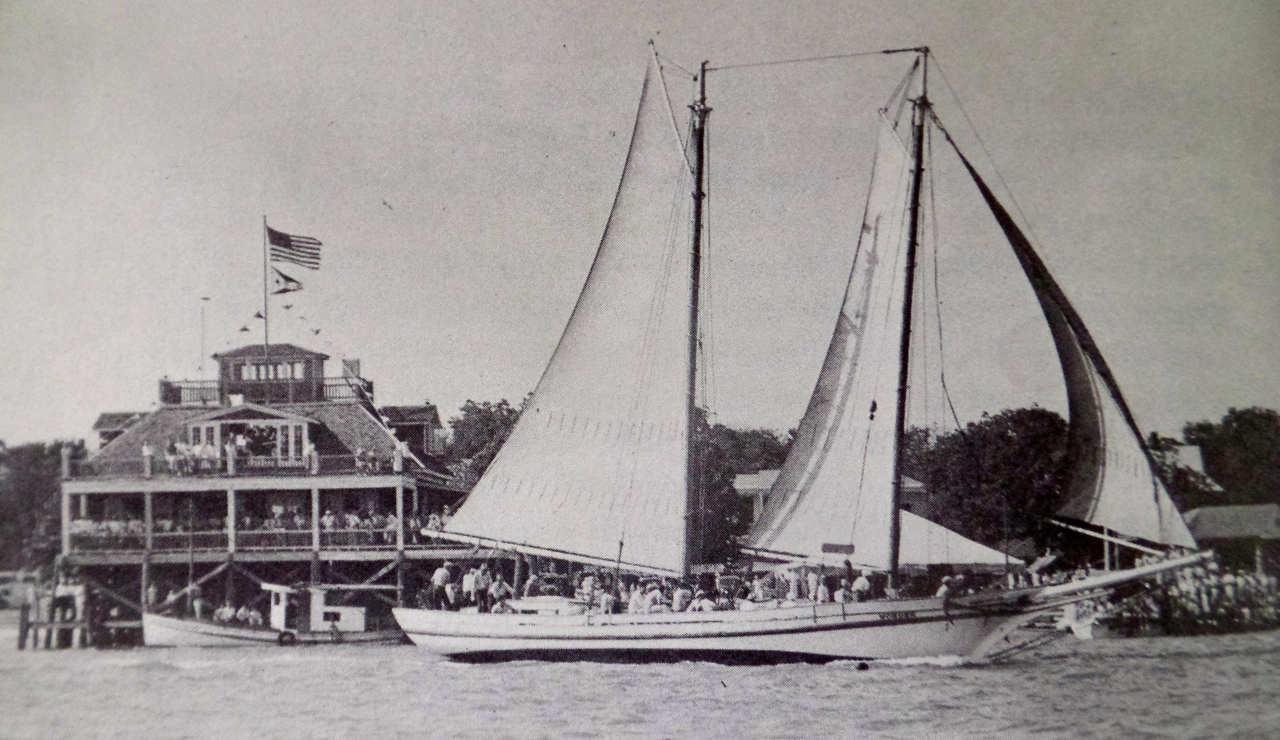
Henry Brasher's Wonder on starboard tack passing the BYC
1905
"What others have said"
[articles germane to Biloxi's seafood industry]
BILOXI
Knowest thou the land where the oyster and mullet,
Are finer than any yet found in our clime;
Where they melt on the palate and slide down the gullet,
With a joy and rapture that's almost sublime.
[Taylor-About Biloxi-On The Gulf Coast, David Holt: Walle & Company Ltd.-New Orleans-1905]
Mississippi Boundaries and its Seafood Industry on the Coast
[by Raymond Fournier (1876-1949) ]
When Mississippi became one of the States [1817] and Louisiana was well established after being purchased from France, the people of Louisiana made a survey of the state and tried to extend their boundary line into Mississippi up near Jackson to the Pearl River line but this was protested and brought to court. The people of that part of the state [of Mississippi] could see what they were about to lose. There were great forests of pine timbers, farm lands and they would have been deprived of great revenue. The lumber merchants and state officials fought the case in both supreme courts of the two states and lost it. They carried it to the U.S. Supreme Court.
In the Dancing Rabbit Treaty in 1830 at which time Mississippi was sold to the Government for part of Oklahoma and thirty million dollars, the Indians claimed the Mississippi River as the boundary line. Thus it was proved that this land really belonged to Mississippi and was taken back by the State. The next line was attempted about 18 or 20 miles south of McComb. It was to run east from the Mississippi River to the Pearl River. This took a big slice off the southern end of Mississippi anyway. Had the people of south Mississippi known what was in store for them, the value of those marshlands and what the seafood and trapping industry would come to be they never would have let it go but who cared about just marshland? They really didn't seem to be worth anything, at least, not any thing to fight about. This was free country, you could go anywhere you wanted, anytime you wanted. There was fishing, hunting, no game wardens, no licenses, no non-resident laws, nobody to bother you and so no one took any interest in it. The resources of this part of the State were invisible but the upper part was visible as anyone could see what was there and this is the reason people protested so hard against it. So Louisiana extended her line to the Pearl River and followed it south to the mouth of the river and nothing more was said for a long time until many years later a dispute arose again about the boundary line.
Biloxi
We all know that Biloxi is one of the oldest cities in the U.S., but was for a long time asleep or like something undernourished, and remained that way for many years with its fine harbor and everything to offer an opportunity for business but nothing yet in sight. There were a few residents along front beach, no drive other than sandbed roads for horse and wagons. A few houses scattered here and there all the way out to Back Bay. Howard Avenue was only a sandbed road which at that time was called Pass Christian Road running from Oak Street at Point Cadet to Porter Avenue then crossing where the the L&N Railroad is today and running west all the way to Pass Christian for which it was named and was the only means of traveling along the Coast.
There were very few residents along the Coast, a few in Mississippi City and Long Beach and on up to Pass Christian. The few families who lived around Biloxi made their living planting gardens, some catching oysters and fish and selling the few they could, some raising cattle, herding and driving them as far as Mobile, crossing [the] Pascagoula River and others on ferryboats and selling them for beef. Sometime later the sawmills began to start sawing timber and they picked out places along the different rivers where there was navigation and created a market for lumber. Ship Island was then used for an anchoring ground for ships.The mills would load the lumber on smaller vessels which would convey it to the ships. The butchers then had a market for their meat which was mostly raised across the north side of Back Bay. They would butcher their meat, bring it across the Bay in rowboats, load it in wagons, haul it to front beach of Biloxi and there to Ship Island in boats that were used for freighting provisions and other things to the ships. That created some circulation of money and the fishermen began to get a little business so there were a couple of little oyster shops built and people from the country would cross the Bay in rowboats which were then used for ferrys to buy from these shops. They would have a little money along to buy groceries too. The stores would get their supplies by water either from New Orleans or Mobile. There was no railroad as yet and after a few years of this slow but sure going the railroad came along, the L&N, from Mobile to New Orleans. This was a little before or after the year 1870.
Early Shippers
With transportation, an opportunity for shipping seafood out of Biloxi arose. Sawmills being established all over the backwoods and the raising of cotton and other products built up a lot of towns, increased the population and opened a market for seafood by shipping via New Orleans and Mobile. The oyster dealers would dispose of their goods and oyster shops began to spring up. William Gorenflo started a business near the Campgrounds [Methodist Seashore] on front beach as did a man by the name of Domingo and also Jimmy Maycox [sic]. These three shops were between the Campgrounds and the Lighthouse.
Farther east on front beach of the harbor was Philmore Desporte. F.W. Elmer, Sr. established an oyster shop at the foot of Main Street. Main Street is the oldest street in Biloxi and runs all the way from front beach of Biloxi to Back Bay*. John T. Maberry [sic] started his business at the foot of Oak Street and started shipping oysters and the business began to extend farther up the state and into Alabama and Tennessee and Louisiana.
Laz Lopez
Just about this time, Laz Lopez came to Biloxi and stayed around doing odd jobs here and there. Laz Lopez was a very brilliant man, not altogether in education but in business sense. Thus he went into the oyster business starting on a small scale and becoming one of the largest shippers. He built up his business as he went along sometimes having to wait for his returns from his shipments in order to pay off his fishermen. The fleet of boats was now large enough to go out into the marshes where the oysters were better and more plentiful and would get paid on their return. He acquired a good business and quiet a few shells had accumulated. These shells were put to good use and used to surface the streets and a road was built from Point Cadet to Porter Avenue. The shells were also used on the front beach to surface it. The shells were hauled in wagons and dump carts and spread on the road and left for horses and wagons to smash, as there were no crushers.
Biloxi Canning Company
Business being good, William Gorenflo, Mr. [W.K.M.] DuKate, Carl F. Theobald, who was an old Biloxi resident, got together and built the Biloxi Canning Company, the same plant at the foot of Reynoir Street out on Back Bay as now stands. This plant was built was built not only for the oyster business, but these men had in mind the packing of steamed oysters but how were they to get at it? They knew nothing of the handling and processing. They became acquainted with a Mr. Patton, Charles Patton of Baltimore, Maryland. The state of Maryland is the “mother state” of the oyster packing industry and Mr. Patton was an experienced man in the business. He was planning to go to California to pack fruits and vegetables. They had him stop over in Biloxi for a while to show them how to pack oysters and so started their business and were successful, though only on a small scale.
There was no can manufacturing in this part of the country and cans had to be gotten out west or in the northeast where can were then made. The boats would bring plenty enough oysters in but the process of packing was very slow because everything including the sealing of the cans had to be done by hand, using soldering irons much the same as plumbers and tin Smith’s are now. The solder was made in triangular bars about 1/2 inch thick and about 18-inches long. Rosin was used for soldering fluid. Later on the half-way round iron was adopted. It could spin around the cap and this helped some and made a little more progress.
After getting pretty well started, Mr. Patton decided to continue his journey west and told his employers he was ready to leave. They decided to call a meeting. Mr. Gorenflo, DuKate, Lopez, and Patton were present and the subject was Mr. Patton’s departure. Some of them were willing to let him go but Mr. DuKate said that Mr. Patton was needed as they still had more to learn. Of course Mr. DuKate has another idea. They agreed then to get him to stay awhile longer, but he insisted on going. Mr. DuKate was anxious to see him stay and made him an offer which the rest agreed to and was that if he would stay his salary would be increased and he would be given a fifth interest in the business. Mr. Patton accepted.
Shrimp
Prior to that time some shrimp had been handled by picking the heads off, boiling them and putting them in 2, 3 and 5 gallon cans in preservaline, each packer using his own formula. John T. Mayberry, being a chemist, made his own formula and it was the best of all. A good many of the others tried to buy the recipe but he would not sell to anyone. After Mayberry died, his wife gradually drifted out of the business and gave the recipe to Ulysses [Lul] Desporte, who succeeded his brother Philmore, who has been in the oyster business. He made use of the formula until it was outlawed by the health department. Preservalene didn't seem to appeal much to the members of the Biloxi Canning Company though.
Canning shrimp
Sometime after Mr. Patton agreed to stay with the company, Mr. DuKate came upon a new idea. He consulted Mr. Patton and asked that if he didn't think since oysters could be canned and processed that shrimp could be as well. Mr. Patton agreed and and began to experiment but it wasn't as easy as oysters. They had quite a job. They boiled shrimp in a vat by putting them in sacks, tying the sacks, boiling a few minutes, having them peeled, put in cans and processed. After a few days, the cans were opened but the shrimp didn't look too well. They tried again and again, using different tie in boiling and processing without success. Something was wrong each time. The shrimp would always have a dark stain. They were about to give it up and that called for another meeting. Mr. Patton was asked what he thought about it. Should they give up? Mr. Patton said no as he had another idea. His idea was that the cans should be lined. They tried it using white cotton cloth and had bags made , filled with shrimp and put them in cans, sealed and processed them. After a few days the cans were opened and there was no stain. This was the start of the shrimp packing industry. Every woman in the neighborhood who had a sewing machine had a job sewing bags for them and kept it up for a few years until better methods were discovered. Mr. Patton should be credited for his knowledge that started others in the packing business and so from time to time the methods improved and the capacity became greater and greater and as the industry became larger they began to expand.
The Dunbars
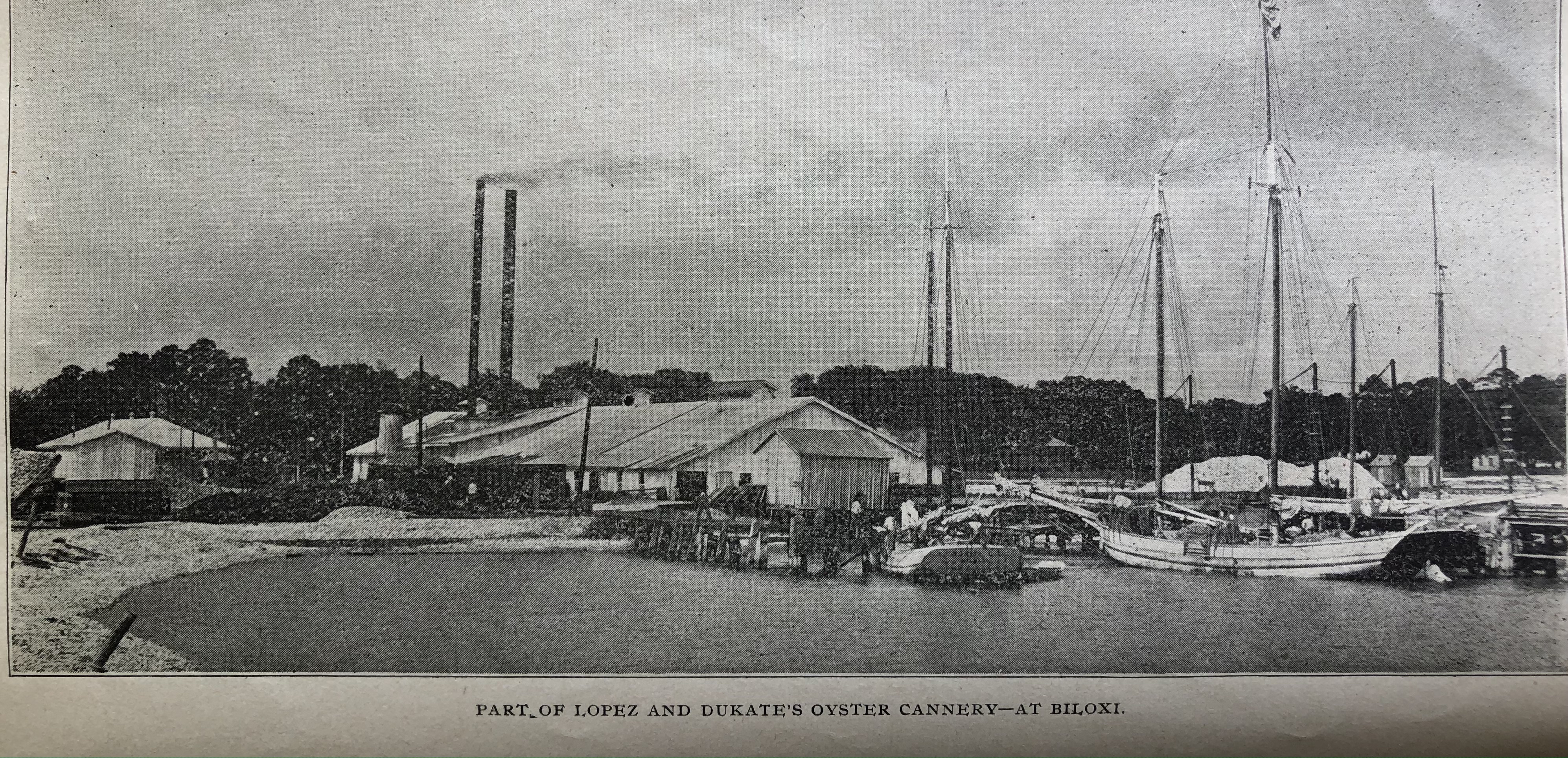
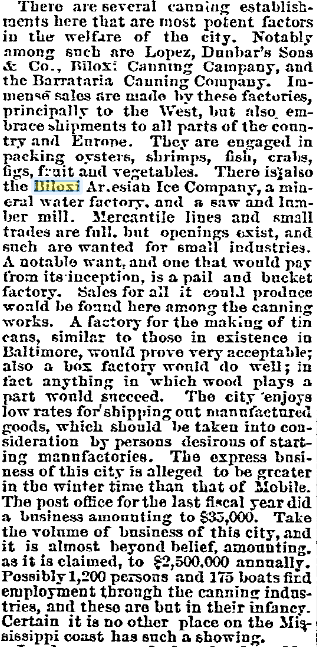
The Dunbars has [sic] been operating a factory in New Orleans and decided to come to Biloxi and establish a factory. They merged with Mr. Lopez, took some of the machinery from their plant in New Orleans, brought it to Biloxi and the Lopez, Dunbars Sons & Company established a factory just east of the foot of Oak Street. Lopez, Dunbars & Sons was established in 1884 [sic]. The Dunbars were residents of Louisiana. After they got started the Barataria Canning Company established a factory at the east end of Point Cadet and started packing oysters and shrimp. They handled raw oysters as well as steamed oysters, all imitating the old Biloxi Canning Company.
The Hitchcock Company
By that time Biloxi began to wake up and along about the year 1890 a company from Baltimore came to Biloxi to establish a factory, the Hitchcock Company, just east of the Lopez, Dunbar & Sons Company and situated between this company and the two others. This one had just gotten started when the Lopez Company bought them out, made improvements on it and used it for their main plant.
By this time there had been considerable improvements made in the handling of shrimp. As the shrimp had to be bought in from the marshes, which was quite a distance, the boats had to carry ice to preserve the shrimp. It was discovered that if these iced shrimp were picked before they were boiled, they would pick easier, boil firmer and there was much less bulk. The sealing of cans was much easier and faster. The caps of the cans were now solder hemmed. The capping irons were made perfectly round to fit the the cap, also the regular soldering fluid came into use and just a small brush was needed to dip and pass over the caps, drops the iron in place and the can would be sealed all around at one time.
Of course there were several men sealing at the time and after buying out the new plant the Lopez, Dunbars Sons & Company, would steam the oysters, have them shucked, have the shrimp peeled, and transfer both to the other plant across a little bridge built with tracks on which a small car was rolled. The L&N Railroad Company ran a track from the crossing at Oak Street to the warehouse where they could be easily loaded.
In the meantime after the purchase of the Hitchcock plant, the Lopez Company paid the Barataria Company for a five-year shutdown. This meant that they would not handle oysters other than that what could be gotten from the grounds leased from the Otts who owned from the east end of Point Cadet to the L&N Bridge and which was a bedding ground. Under this contract they were allowed to handle shrimp. Thus, the Lopez, Dunbars Sons & Company monopolized the packing of steamed oysters. Their business became so large they had to import labor.
The Bohemians
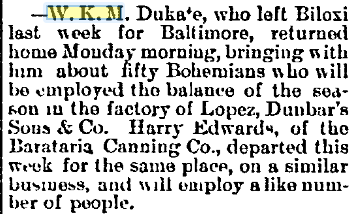
Now there were numbers of Polish people and others who worked in vegetable factories in the North during summer months and were idle in the winter. These people were offered a job which they accepted. A train was chartered which brought them to Biloxi. Now in order for the company [Lopez, Dunbars Sons & Company] to get back the cost of their transportation, little brass checks about one-half inch wide and 1-inch long were made. These checks were worth $.07 1/2 cents each. These imported people had a separate place [in the factory] from the native people to weigh the oysters they shucked and the checks they would get were punched and worth only $.06 cents. This made them pay $.01 1/2 cents on each cup of oysters for their transportation. These checks were good only at their own places of business until that was outlawed and employees had to be paid in cash. From then on the difference was made up in the weight.
Parchment liners
While the Barataria [factory] was closed on the oyster business they kept on packing shrimp. The general manager's name was Isidore Heidenheim and the foreman was George Edwards from Baltimore. He had three sons and a daughter: Harry Edwards, Eddie Edwards, George Edwards Jr., and Jennie Edwards who married the elder Louis Johnson of Biloxi. Old Harry Edwards died and his elder son Harry took his place as foreman. He began to experiment a little more on shrimp. There was a kind of paper manufactured in Philadelphia, Pennsylvania called parchment which was water and stain proof. He used a sample of it and cut it to fit the cans with a circle for the tops and bottoms and packed shrimp with this parchment liners. It proved to be a lot better and much easier than the cloth line and all other packers adopted it and gave the size they wanted to the firm in Philadelphia and from then on they were shipped to Biloxi by millions in packages of 500 each cased up in 50 and 100 thousand lots and were used until just a few years ago when the enameled tin cans came into use. Now the cans don't need lining.
Packing wet shrimp
Harry Edwards also packed the first wet packed shrimp. All the shrimp packed in the first few years were dry and the market was out west and until yet the market is better
__________________________________________________________________________________
65 Years of Mississippi Seafood History
[published in The Daily Herald on July 3, 1933, p. 16 ]
Fish, oysters, shrimp, crabs-these seafoods have played a large part in Biloxi's history, not only being important as foods in the days "befo de wah", but they have played a large part in the town's business and economic history for more than 65 years. In the early days, when New Orleans and Delta families began to establish summer homes here, there were men who made a living for their families by catching and selling seafoods. Some few Coast residents are living, who can remember the time when fish were kept in heavy net wire boxes at the ends of the fish wharves. The fish box was drawn out of the water by windlass and the purchaser indicated this fish or that as the one desired-and the windlass lowered the box back into the water. It is said that most of the fish wharves were run by Spaniards. Years later, when ice was manufactured here, the present of iced fish came into use. The only ice previous to the establishment of the plant here in 1884 came from Mobile.
Oysters were first shipped out by schooner, in bushel sacks, of course unopened, and went to nearby points. With the coming of the railroad in 1870, they were shipped by rail, still in bushel sacks, to Montgomery, Vicksburg, Memphis, etc. Filmore Desporte (1856-1891) is credited, by his family, with being the first man to ship raw oysters out of Biloxi, sending them to Yazoo City, but others claim that a Spaniard by the name of Fresquitte [Peter A. Pons and Antonio Catchot of Ocean Springs were shipping oysters to New Orleans and Mobile by rail as early as 1872] was the first shipper of raw oysters having sent them to his brother in Vicksburg.
In the early days, oysters were eaten all the year round, with the summer trade the best, as the summer colonists enjoyed them as a change of diet and meat was not easily procured. Now there is a tradition that oysters should be eaten only in the months in which an "r" is found-though of course they are eaten the year round by many.[Not true. In the 1860s people were using the 'r' rule. see The Daily Picayune, 'About oysters', September 8, 1867, p. 8]
The late William Gorenflo Sr. is generally credited with being the pioneer in the shrimp and oyster industry and is authority for the statement that the finest oysters in this vicinity are to be found in Back Bay on "Ballast Bank", where it is believed from articles recovered from the water at that point, that the d'Iberville boats, in order to get up the bay to safe harbor, threw overboard guns, boxes and belongings. This reef was about to be exhausted and Mr. Gorenflo proposed that several thousand barrels of shell be planted there, which was done, with successful outcome. The preservation of this bank was carried on in varying ways for many years. For a long time, oystermen were compelled by city ordinance to open all oysters caught there, on the bank, returning the shells to the water. This however, was changed a few years back, in the interest of sanitation.
Among the first shippers of raw seafoods were the senior Mr. Gorenflo. L. Lopez Sr., F.W. Elmer Sr., and his father-in-law, James Maycock, all now deceased. The first shipping plant was at the foot of Main Street and Front Beach; later the plant was moved to Reynoir and the Beach; for one season they were in front of the Drysdale property, now known as Beach Hotel; then they moved back to the foot of Reynoir street, where they leased their ground from the City for two years.
Next, the two rival companies merged and were joined by W.K.M. Dukate who had come here as a Western Union operator, and the plant was moved to the north end of Reynoir Street and called the Biloxi Canning Company. The beginning of the industry- in its present type- is placed at about 1874.
H.J. Meaut, perhaps the last surviving Biloxian of those stirring days, was Mayor in 1875 and he was the first man to use shells for the building of roads. He had them used to fill in the ruts in the long road which led out Reynoir Street to the Bay, and placed clay in the center of the road where the horses walked. This led to the system of shell roads and streets, for which Biloxi was famous for years, before the automobile forced the building of hard surfaced roads.
By the late seventies, the oyster industry was well launched. Oysters were steamed before being opened and canned in their own liquor, with a process not so different from that use now.
Packing Shrimp
The effort to pack shrimp was fraught with many weary hours of experimentation, with heavy loss of funds and many heart breaking experiences, before there was any measure of success. The present sanitary wholesome can of shrimp is the result of years of continuous research and experimentation.
In the early days the factories boiled the shrimp in the hulls, placed them in large muslin bags and a cart delivered them to the homes were the entire family assisted in hulling-the carts returning for the flesh for canning and the hulls from which fertilizer was made. This was slow and expensive, the some bright mind suggested picking tables under the large trees near the plant and later the tables were established on the long gallery which ran around the factory and this led to the present type tables in buildings around which pickers stand.
The problem was keeping shrimp from turning black in the cans. The senior Mr. Dunbar, another family name long prominent in canning companies, was a shoe salesman in Massachusetts when the War Between the States opened and sent his wife and family to France to her people. There the boys learned to make syrups and cordials and upon their return to the States, such a business was established in New Orleans. Mr. Dunbar wished to can shrimp and many times made money with his syrups and cordials, only to lose it in is efforts with shrimp. His wife suggested a muslin bag inside the can. This was tried, found good, and the idea patented. Biloxi packers were using corn shucks, cut to line the cans. The shucks were hard to obtain in quantity, and were cut by hand and the packers were eagerly looking for a safer, quicker method. Seeing the late T.P. Dulion open a cheese box in the old Lopez grocery, the elder Gorenflo thought he had found a way. Veneer wood was secured from Cincinatti. the idea patented, dies bought for cutting the tops and sides for the lining and about a 100 cases canned.
Opened a few weeks later, they were black as ink. They then built a huge tank, turned pipes for live stream into this and with a great quantity of soda, this veneer was boiled and reboiled until the wood was white and the water clear, and the pack was considered successfull. About this time the Dunbar patent expired and they could use the muslin bag. Next a parchment paper lining came into use, but this was expensive as it had to be bought abroad. A few years later an American parchment could be bought and this was used until about six years ago, when some research department, government or canning company, found a laquer for cans, which resisted the fruit juice effects and this could be used for shrimp. Two types of laquer have been used, but the fruit juice type came into use about four years ago and is the best thing yet tried.
However, the canning of shrimp is not easy and through the last few months scientists of a can company research department and from the government, have been at work here, trying to remove the last uncertainties from the process. It seems the best way to test shrimp for spoilage is by odor, as a bad odor will show up long before the meat is dangerous for consumption.
Factory whistles blow from 4 a.m. on and the shuckers hasten to their posts as work must be well started, before the canning crew can get underway. One factory here was credited with canning 1500 barrels in one day, this spring, working from, 4 a.m. to 7:30 p.m., which is a phenomenal pack.
Since 1900 there have been a few women who have taken important parts in the executive end of the packing or raw shipping business. The first of these, Mrs. Sophie Kuhn Desporte, went into Mr. Desporte's plant at the foot of Lameuse Street, shortly before their marriage. They worked together, he handling the buying of the raw seafood product and the workmen and she handling the office and selling except she also kept an eagle eye on everything that went on in the plant. Her hours were often from 4 a.m. till long passed dark, but Mr. and Mrs. Desporte had a successful plant. She continued in the work until 1925, when Mr. Desporte's health broke. The plant was leased for some years, but is now completely closed.
Mrs. Joseph Edward Wentzell was the next local woman to enter the executive end of the seafood business and with her husband and his brother has run a raw shipping for some twenty years or more.
The late Mrs. I. Heidenheim who was Miss Anna Eve Riego (1874-1931) of New Orleans before her marriage went into the office of the old Barataria Company in 1913. When this company was reorganized in 1917, she was given an executive position and upon her husband's death soon after, she became general manager, in which capacity she served until her death a few years ago.
Mrs. Mary Skrmetti Anticich was the next woman to enter the executive end, taking over the management of the Biloxi Trading and Packing Company in 1919 when she was quite young. Mrs. Anticich was born in Isle Brac, Dalmatia Province, now Jugo-Slavia, coming here with her parents when she was about two years old. She is credited with being a good business woman at the age of ten, as she had served as interference between her father and uncles and the bankers and businessmen since she was so little she was placed on a table in their midst. Mrs. Anticich now operates the Anticich Packing Company and some allied interests.
Fortunes in this industry have never been stable. One company will go broke in a certain locality, only to have another company take the same location and wax rich-this has happened often in Biloxi and oftener than in other industries. It is common for a foreign born boatman who came here to work for some company, to learn the business, gradually save money, and buy a boat, or "work one out" for a factory and with his sons finally go into the canning business with some member of the family in each department. Many of them get rich, others suffer the usual ups and downs financially. But a packer long familiar with the industry here, states that in her belief, the industry in the next several years will be in the hands of and governed by these families and groups of foreign born, or decent, owners who work right along in the factory.
______________________________________________________________
REMEMBER
by Ernest Desporte
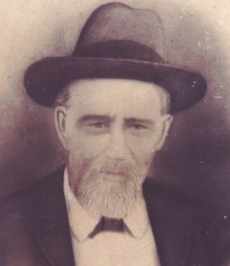
Antonio Pons
Biloxi’s Retail Fish Business
Between Main and Reynoir Streets flourished a unique retail fish business. Each fish dealer had a small building on the south side of the wharf from which he operated. As fish could not be sold unless alive, they had live fish boxes that could be raised and lowered into the water to an advisable depth. The boxes in which the live fish were kept were made so that water flowed through them, giving the fish fresh moving water.
The fish dealer owned skiff, trammel nets and a large fish car. The car was a contraption in which the catch was put. The fisherman would take two skiffs, a set of trammel nets and row over to Deer Island or along the coast looking for enough fish to set their nets. Accompanying them was a man with the fish car in which to put the fish. When the car was sufficiently filled, the car attendant would swim it to the dealer, as he had no other means of propelling [it].
The fish was transferred to the dealer’s fish box. When a customer came, the fish box was raised from the water for the prospective buyer’s inspection and the choosing of his fish swimming in the water. The fish chosen was scooped up and strung on a piece of palmetto for the buyer. Names of men in this business were: Magrots, Matlaya, Antonio "Tony" Pons [1844-1911] and Louis Solari [1868-1932].
The Flounder Torch
by Ernest Desporte
The evolution of the torch used to flounder with-first we used a wine basket suspended from a shaft about five feet long. On the butt of the shaft was part of a wooden hoop which was held against the body. The fuel was pine knots. One man carried a sack of pine knots and the other the torch. Whne you passed under a wharf and somebody dropped a little bag [of sand?] on your torch, it hit the water and you usually did also!
The next type of torch which came into use, which was a big improvement, was one in which you burned cotton balls. You would make a half dozen cotton balls and soak them in kerosene oil. One party would carry the torch, while his partner would a carry a twelve quart bucket in which was the cotton balls soaking in oil. This was also a good one to sandbag. Usually when a small [sand] bag was dropped on the shaft, your torch hit the water and you were in complete darkness.
The next improvement in the torch was the use of an asbestos ball suspended from a pipe attached to a tank filled with kerosene oil that dripped on the asbestos ball. That was the last type of torch used. The coming of the reflector gas or electric light eliminated the fun of sand bagging.
__________________________________________________________________________________
A Story of Mississippi’s Seafood Industry

 The Mississippi Croatian Story: Overcoming Adversity
By Kat Bergeron
Sun Herald, South Mississippi’s News Leader
(Reprinted with permission from the April 27, 2014 issue)
The Croatians of the Mississippi Coast love to tell the story of Nikola Skrmetta, who immigrated from the Dalmatian Coast in the late 1890s. Biloxi was growing strong seafood legs, in need of workers to harvest and can oysters and shrimp. With a legendary strength of 10 men, he went to work in the labor-intensive industry.
This one man is credited with starting an early 20th century immigrant title wave of other Slavonians coming to work on the Gulf Coast. The story goes that Nicholas “Nick” Skrmetta – his Americanized name – jumped ship in New Orleans and soon found himself in Biloxi. As he stood at a trolley stop he struck up a conversation with Laz Lopez, owner of a factory and fleet of schooners. The story further explains he could not speak English and Lopez could not speak Croatian so they communicated in a mixed European language that included Italian. That day Lopez offered Skrmetta a job. Lopez was so impressed with his energy and hard work that he asked, “Are there any more like you?” There were. Hundreds of them. Their offspring number in the thousands now. Skrmetta convinced family and friends that America was the land of opportunity. At that time, their homeland was under the thumb of the Austrian-Hungarian Empire. Life was tough for non-royals, and many young men were being conscripted into the army, known for its cruel treatment of soldiers.
The Daily Herald in May 1905 declared in a headline: “Many Slavs Coming, are Driven To America by Untoward Conditions.” Wars and conquerors had historically pockmarked the peace and prosperity of their Central European homeland.
In 1903 in response to Skrmetta’s convincing, the first contingent of “Austrians,” as they were then called, arrived by way of Ellis Island. This group of five from the village of Bobovišće, included Steve M. Sekul and Peter M. Skrmetta. They were as hard working as the first Skrmetta, and factory and schooner owners wanted even more like them. Austrians obliged. That first group sent for wives and children and more men to work, a move repeated again and again.
Freedom in America
Eventually whole extended families settled in Biloxi, forming a close-knit community on the peninsula known as Point Cadet. When Skrmetta died in 1918, the Herald reported he “will be greatly missed by Biloxians, and especially those of his people who relied on him for advice in their affairs.” Women and older children worked in canneries, as did some of the men, although many worked on the boats and docks. At first they lived on Biloxi’s version of Cannery Row, in small camp housing, but they saved and eventually built their own fisherman cottages. Some bought their own schooners.
This early 20th century wave of immigrants has been variously called Austrians, Yugoslavians and Croatians, depending on what stage of history their homeland was in. About 250 families came in that wave, and they tended to have lots of children. “In America it wasn’t an easy life, but they could live free and that was most important,” said Anthony [sic] “FoFo” Gilich, president of the century-old Slavonian Benevolent Association of St. Nichole headquartered in Biloxi. “Coming to the United States was a big opportunity. The first Croatians were ambitious, and some became factory and boat owners, even factory owners themselves, or their children did. Education was important and that lead to Croatian doctors, lawyers, pharmacists and business leaders. “They had arrived with little money, no safety net and no assurance of success. They taught us leadership and not to be afraid of anything.” Gilich, at 66, is a computer program developer and grandson to one of the 1903 Dalmatian arrivals. Gilich’s first job was “catching cans” off the conveyer belts of Sea Coast Packing Company, owned by his grandfather and located where the Golden Nugget Casino now sits. He estimates that less than five percent of the descendants now work in the seafood industry.
Coast Waves of Slavs, French, Polish
These early 20th century immigrants supplied much of the brawn for the Coast’s seafood industry, the region’s economic engine. But the Croatians were actually the second wave of immigrants to make Mississippi seafood buzz. In 1890 the first so-called Bohemians arrived by trainloads to work for factories to fill a local labor shortage. These seasonal workers, mostly of Polish background, came from Baltimore.
Already, a few Croatians had settled in the Gulf region to work with oysters during the post-Civil War Central European migration. Explained a November 1893 Herald: “They are Austrians or descendants of Austrian parentage, a hardy, economical and industrious class – worthy and good men…”But the wave of Slavonian immigrants spurred by the Skrmetta-Lopez acquaintance didn’t begin until 1903. That was followed in 1914 by the first Acadians, or Louisiana Cajuns, then in the late 1970s by the Vietnamese.
Few of the Bohemians, seasonal by nature, stayed permanently so their place in seafood history is an early dot, and the Vietnamese are still writing their chapter. A century later, the French and Slavonians have proven their staying power. “Like a lot of immigrants they went from being workers and laborers to being prominent citizens, politicians, lawyers, business owners and doctors, playing important community roles,” said Murella Hebert Powell, Biloxi’s historian emeritus. “In the beginning they were the backbone of the seafood industry. “It’s remarkable that the Acadians and the Slavonians, who at first couldn’t talk to each other because of language barriers, were soon marrying each other. Yet, each of these groups have managed to hold on to their own identities. The French still have their Fleur De Lis Society and the Croatians have their Slavonian Benevolent Association. “They became a melting pot but they retained that individuality as a people. The Yugoslavs were making gumbo and the Cajuns making pusaratas.”
Pusaratas are a type of European fruit doughnut ball still popular on the Coast and gumbo is a seafood stew brought from Louisiana.
Tradition! Tradition!
Croatian traditions remain strong, although like many Americanized cultures, they are fading. The native-language songs, often accompanied by an accordion, are now more of a rarity than commonplace at the Slavonian Lodge. Their South Slavic language, too, is rarely heard on the Coast.
“I didn’t grow up speaking the language,” said Capt. Pete Skrmetta, 88-year-old patriarch of the family that runs the Ship Island ferry and son of the 1903 Skrmetta immigrant of the same name. “That was the only language my father spoke when he was young, but he married my mother from Bay St. Louis and she didn’t speak it. But he’d continue to use the language when speaking with the Croatians who worked with him catching oysters and shrimp. Some of the kids in school, like John Misko and Peter Barhanovich, was raised up with the language and they spoke it. “We were all raised up with the Cajuns and the Polish people, we all went to school together and were friends. The Cajun people liked to fais do do, have a good time. The Croatians were very serious people, we worked hard, saved money and invested. Where we came from, only the strong survived.”
Religion also played an important role, as evidenced by St. Michael Catholic Church on Point Cadet, known as the “Fishermen’s Church.” It began as a mission in 1907 for the immigrants living in camp houses and working long hours each time factory whistles blew to announce fresh seafood arrivals. The modern version of the church, with its seashell dome, is noted for its Christian symbols of the sea. A generation ago, St. Stephens Day was a huge Slavonian observance, with the making of a special wine called Prucke from European raisins. One tradition that continues is the spring Blessing of the Fleet, an ancient European tradition open to fishermen of all cultural backgrounds to assure a bountiful and safe harvest. Many of the seafood festival kings and queens have come from this Croatian community.
A Cultural Center Still Abuzz
The Biloxi lodge remains the center point for this immigrant community, now two, three and four generations as Americans. Parties, balls, weddings, even funerals are held there, and stone plaques list all deceased members. They first formed in 1913 as the Austrian-Slavonian Benevolent Association to fill the social needs as well as subscriptions to pay sick and disabled seafood workers.
Tragedy struck early when in 1916 the treasurer, also a founder, killed himself after admitting to misappropriating funds for personal use. Accustomed to adversity, they moved forward.
In 1921, in response to Yugoslavia now holding sway in their homeland, Biloxi Croatians got a new charter as the Slavonian Benevolent Association “St. Nicola.” The lodge they maintained became the center of their lives but was visited by others who gladly shared their traditions and entertainments, especially their dances and music. In 1956, the lodge installed an air conditioner at the behest of member Yankee Barhanovich, a promoter who planned a set of concerts that included Elvis Presley.
The current lodge, now called the Croatian American Cultural Center, replaces the one on Myrtle Street built in 1938, inundated in 1969 by Hurricane Camille and destroyed in 2005 by Hurricane Katrina. They say that building back, better than before, is proof they’d learned the lesson of overcoming adversity. It is an impressive $4 million building, reflective of the Croatian community’s prosperity but especially of the importance that descendants put on their roots.
Oh So Many ‘iches’
Mississippi’s American-Croatians continue to visit the homeland, where some still have ties. Many have links to Dalmatia, an historical region of Croatia on the eastern coast of the Adriatic Sea. Among the many islands of this region is Brač, from which hailed recognizable Coast names, Mavar, Pitalo, Sekul, Skrmetta, Radish, Marinovich, Kuljis, to name a few.
The local joke was if the names ended in “viches and iches” you could safely bet they had Slavonian roots. Among others lucky enough to leave their war-torn homeland for Mississippi shores brought the names of Stanovich, Rosetti, Barhanovich, Mladinich, Marinovich, Simonich, Trebotich, Peresich, Cvitanovich, Covacevich, Fillipich, Radich, Polovich, Popovich, Gruich, Gabrich, Cerinich, Misco, Hire, Ragusin and Halat, to name a few more.
They never forgot where they came from, nor did those they left behind. In September 1937, the Southern Slavonian Herald, an English-language newspaper that published in Belgrade, featured a Biloxi water scene and this explanation that was repeated in the Daily Herald: newspaper that published in Belgrade, featured a Biloxi water scene and this explanation that was repeated in the Daily Herald: “Not Dalmatia’s Romantic Riviera, but the Mississippi Gulf Coast at Biloxi, where for more than 50 years Dalmatian fisher-folk have had this colony and where hundreds of Jugoslavs are today engaged in the fishing and canning industry.”
(Kat Bergeron, a veteran feature writer specializing in Gulf Coast history and sense of place, is retired from the Sun Herald.)
Biloxi Seafood Chronology
Pre-1900
1860
State of Mississippi passed an Oyster Law on February 10, 1860.
1865
Jackson County, Mississippi had the 1860 Oyster Law amended to remove impediments to the oyster trade in Jackson County. These amenments were: Article 9-"an act to prevent the destruction of oysters" is repealed. Section 2-"Be it further encated, That said act of the 10th of February, 1860, shall not be construed as to take away or in anywise impair the common rights of citizens of this State to the free use of the natural oyster beds which may exist in its waters." Section 3-"Be it further enacted That it shall not be lawful, under the provisions of this act, for any person to take oysters or clams situated upon land which is the property of another person, without the consent of the owner." Section 4-"Be it further enacted, That this act taked effect from and after its passage." Approved November 24, 1865.(The Laws of Mississippi, Chapter CCXLVII, p. 453)
1867
New Orleans has always been a large oyster consuming city. The general opinion in 1867 was that the best oysters, called Barataria, were harvested from the coast of Louisiana on both sides of the Mississippi River. Raw oysters from Pass Christian, Biloxi and other Mississippi coastal communites were also being shipped to the Crescent City for consumption. Fourteen barrels of harvested oysters was considered an average days work. People at this time were adhering to the 'no R rule', i.e. oysters were generally not eaten in months of the years that had no 'R' making the oyster gathering and eating season September thru April.(The Daily Picayune, September 8, 1867, p. 8)
1872
Peter A. Pons & Company-Dealer in Oysters. Will ship on line of New Orleans, Mobile & Texas Railroad.(The Handsboro-Democrat, October 5, 1872)
1876
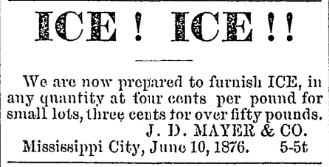
[The Handsboro Democrat, July 1, 1876]
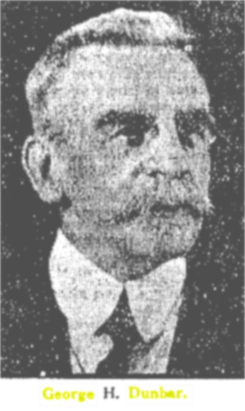
In July 1876, George Washington Dunbar (1816-1878) and George Hacker Dunbar (1844-1917), his son, went to Washington D.C. and obtained a patent in the processing and canning of shrimp. George H. Dunbar is credited with improving the packaging of shrimp as to retain its freshness, color and delicate flavor. The US Patent Office granted the Dunbar patent without hesitation after its chemical inspectors examined the Dunbar product.(The Daily Picayune, July 16, 1876, p. 11)
Deer Island Oyster and Fish Company-"Oysters and fish in any amounts. Oysters supplied, open in cans, buckets, or in shell, or, by the sack or car load."(The Biloxi Mirror, September 9, 1876, p. 3)
1877
Emile Laudner, nee Ladner, (1840-1890), proprietor of the Deer Island Oyster and Fish Company bought a lot on the beach front at Biloxi between A.C. Nixon and H.P. Buckley from Burissa Bradford Holley (1808-1881) in January 1877. Emile Laudner became a two term Mayor of Biloxi (1883-1884 and 1887-1888).(Harrison Co., Mississippi Land Deed Bk. 15, p. 401)
1880
Louisiana was the first of Mississippi’s coastal neighbors to pass legislation preventing the removal of oysters from its waters. In 1880 and again in July 1882, their legislature ruled in House Bill No. 308 that “no person who is not a citizen or resident of the State of Louisiana shall be permitted or allowed to plant oyster beds at or in, or to take oysters by fishery from any place above enumerated within the limits of or under the jurisdiction of the State of Louisiana.”[The Daily Capitolian-Advocate [Baton Rouge], July 3, 1882, p. 3]
The
1881
The Harrison County Board of Supervisors appointed William F. Gorenflo, James Maycock and J.D. Mayer to draft an ordinance regulating the catching and cultivation of oysters in Harrison County, Mississippi.(The Pascagoula-Democrat Star, May 20, 1881, p. 3)
The Lopez, Elmer and Company. This company was organized in 1881, with a capital stock of $8,000 by Lazaro Lopez (1850-1903), F. William Elmer (1847-1926), W.K.M. Dukate (1853-1916), William Gorenflo (1844-1932), and James Maycock (1826-1892). The Pascagoula Democrat-Star reported on December 30, 1881, that the company was placing its canning machines in the factory. The proprietors had over one hundred, local, white men and boys on the payroll. They were employed as follows: forty-four openers, forty-five men manning fifteen boats, twenty or more canners and wharf men.(The Pascagoula Democrat-Star, December 30, 1881, p. 3)
1883
Biloxi Canning Company-The initial efforts of The Lopez, Elmer and Company were crude, but ready markets were available and the organization was profitable. The Lopez, Elmer and Company was dissolved in 1884, and the Biloxi Canning Company, a corporation organized under the laws of the State of Mississippi was chartered on March 23, 1883. The land on which the Lopez, Elmer and Company plant was built in 1881, was purchased from Joseph Diaz Jr. (1845-1923) and Adele Santa Cruz Diaz (1846-1915) on June 29, 1881 for $100.(HARCO, Ms. Land Deed Bk.18, p. 20) The lot had a front of 82 feet on Back Bay and ran south 196 feet. Reynoir Street was the western boundary. Diaz had purchased a tract here in 1873, from John Bradford. It was 82 feet x 950 feet and cost $200.(HARCO, Ms. Land Deed Bk. 13, pp. 553-554) In December 1886, C.F. Theobald, F.W. Elmer, and Charles Patten (1839-1922) of the Biloxi Canning Company bought a lot east of Reynoir with 45 feet fronting on the Back Bay of Biloxi from Nicholas Taltavull for $60. It was 200 feet deep and ran to the Back Bay Road.(HARCO, Ms. Land Deed Bk. 21, p. 549)
1884
Mississippi City crabbers are catching thousands of crabs and getting paid 10 cents per dozen.[The Daily Picayune, October 7, 1884, p. 8]
1885
The Biloxi Canning Company signed a contract with the Victor Manuafacturing Company of Dayton, Ohio for a 5-ton ice machine. Four cold storage rooms 12 feet by 12 feet were planned.[The Biloxi Herald, September 21, 1895, p. 8 and March 28, 1896, p. 8]
The Barataria Canning Company was chartered to operate in the State of Mississippi on April 4, 1885. The incorporators were: Simon Gumble (1832-1909), Isidore Heidenheim (1852-1918), William H. Lengsfield (1851-1925), Isidore Hechinger (1857-1927), and Harry Edwards (1860-1929).(Harrison County, Mississippi Chancery Court Chattel Deed Book 20, p. 462)
General Joseph R. Davis (1825-1896) representing the Biloxi Canning Company filed an injunction to restrain Jackson County, Mississippi officials from enforcing an ordinance recently passed relating to the catching of shrimp.(The Daily Picayune, August 31, 1885, p. 3)
1886
The Yellow Fever quarantine at Biloxi shut down the seafood industry here. The Biloxi Canning Company closed its doors on 22 October and released its approximately 70 employees. These laborers were entirely dependent upon the factory for their subsistence.(The Pascagoula Democrat-Star, October 22, 1886, p. 2)
1887
The Biloxi Artesian Ice Manufacturing Company was founded in early 1887. It was a stock company headed by John Walker (1834-1907), president; Theodore P. Dulion (1861-1907), treasurer; W.K.M. Dukate (1853-1916), secretary and general manager; and R.E. Lee Elder (1865-1931], chief engineer. John Wein (1851-1931), was the assistant engineer.[Dyer, 1895]

[The Clarion [Jackson, Ms], December 14, 1887, p. 3]
1888

[The Daily Picayune March 8, 1888, p. 2]
The Biloxi Artesian Ice Manufacturing Company is now prepared to take ice orders from all along the Coast.(The Biloxi Herald, March 31, 1888, p. 8)
The Oyster Law.(see The Biloxi Herald, April 28, 1888, p. 1)
Edward C. Joullian (1863-1931) acquired the Knights of Labor factory on Back Bay from Rowena L.M. Nixon (1840-1917) and moved his family from Scranton [Pascagoula, Mississippi] this week and is now here permanently. Mr. Joullian will engage in the shipping of shrimp and raw oysters. The tract was conveyed to Joullian for $400. It had a front on Back Bay of 61 ¾ feet and ran south to Bayou Auguste.(The Biloxi Herald, July 28, 1888, p. 8 and Harrison Co., Mississippi Land Deed Bk. 24, p. 84)
[The Biloxi Herald, August 11, 1888, p. 1]
The Gulf Coast Shippers and Packers Association will meet at Elmer's Hall on August 13th.(The Biloxi Herald, August 11, 1888, p. 8
William Gorenflo & Company-packers of canned goods and shippers of raw oysters. Prompt shipments and low prices guaranteed. Located at 209 East Back Bay in 1922.
Lopez, Dunbar's Sons & Company-packers of oysters, shrimp, figs, vegetables, etc. and shippers of raw oysters. Send for price list.
Phil. Desporte-shipper of raw oysters in bulk, opened, or in sealed cans. Front Street, foot Lameuse. Price list on application.
F.W. Elmer-shipper raw oysters. Orders promptly attended to. Front Street near Main.
E.C. Joullain Packing Company-Canned goods and raw oysters. Located at 251 East Back Bay in 1905.
Phil. McCabe-shipper of raw oyster, manufacturer of oyster cans, dealer in groceries, hardware, Pass Christian and Lameuse Streets.
J.T. Maybury-shipper of raw oysters and canned shrimp, and dealer in groceries. Maybury (1841-1894) also from Baltimore. Buried at Mobile. Also mercantile interest.
1889
The by Charles W. Slagle, Peter F. Winebrenner and David E. Winebrenner, all of Baltimore, Maryland. Their plant was situated on Point Cadet east of Oak Street. It was acquired in August 1891, by the Lopez, Dunbar Sons & Company for $25,000. The management of Lopez, Dunbar & Son consisted of of Lazaro Lopez, Frank Dunbar, W.K.M. Dukate, Foucher Dunbar, and George H. Dunbar.[Harrison Co., Mississippi Land Book 24, pp. 69-72 and Book 27, p. 49]
F.W. Elmer announced in mid-November that he was no longer affiliated with the Biloxi Canning Company. He is now in business shipping raw oysters on his own account.(The Biloxi Herald, November 16, 1889, p. 4)
Lopez, Dunbar's Sons & Company has made large additions to their shucking sheds to improve working conditions. White and black workers are needed.(The Biloxi Herald, November 16, 1889, p. 4)
1890 Biloxi Canneries
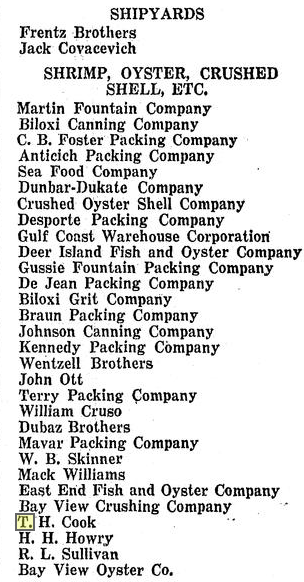
In February 1890, The Biloxi Herald announced that there were six large factories and many raw oyster dealers operating at Biloxi. The journal listed the following canning factories-oyster shippers on February 22, 1890, p. 3:
Biloxi Canning Company-packers of canned goods and shippers of raw oysters. W.A. Gordon, president; C.F. Theobald, secretary.
Barataria Canning Company-I. Heidenheim, secretary. Packers of hermetically sealed oysters, shrimp, figs, and vegetables.
William Gorenflo & Company-packers of canned goods and shippers of raw oysters. Prompt shipments and low prices guaranteed.
Lopez, Dunbar's Sons & Company-packers of oysters, shrimp, figs, vegetables, etc.and shippers of raw oysters. Send for price list.
Phil. Desporte-shipper of raw oysters in bulk, opened, or in sealed cans. Front Street, foot Lameuse. Price list on application.
F.W. Elmer-shipper raw oysters. Orders promptly attended to. Front Street near Main.
E.C. Joullain Packing Company-Canned goods and raw oysters. Back Bay.
Phil. McCabe-shipper of raw oyster, manufacturer of oyster cans, dealer in groceries, hardware, Pass Christian and Lameuse Streets.
J.T. Maybury-shipper of raw oysters and canned shrimp, and dealer in groceries. Maybury
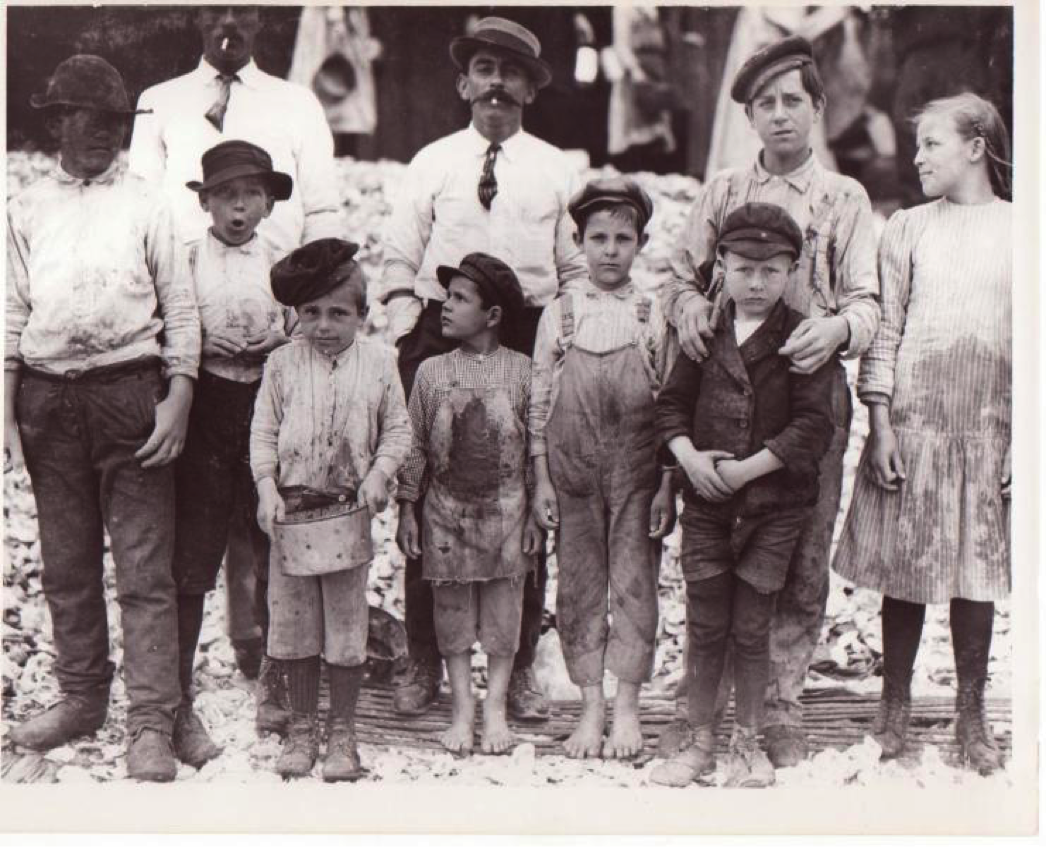
Bohemians
Another salient facet of the Coast’s seafood history was “the Bohemians”. With the exponential growth of oyster canning, especially at Biloxi between the late 1880s and until the First World War, the local labor force was insufficient to meet the seasonal demand of its factories. Among the first migrant workers enlisted to ameliorate this situation were people of eastern European origin primarily from Poland. They preceded by about a decade the major influx of “Austrians”, seafood workers at Biloxi from the Dalmatian coast of present day Croatia.
Kopszywa Family
The Kopszywa family led a peripatetic existence very characteristic of Bohemians at this time before finally at Biloxi, Mississippi. As an example of a Bohemian’s family life, the author has compiled a biographical sketch of this family’s journey from Polish immigrants to productive Americans seafood workers.
Edward Eugene Kopszywa (1887-1962) was born in Sedziskow, Poland. He arrived in Maryland on September 8, 1904 sailing from Bremen, Germany. Circa 1907, he married Mary Misiora (1889-1939), also Polish born, who came to Baltimore circa 1901 from Zagorzyce, Poland. Mr. Kopszywa became an American citizen at Baltimore on June 17, 1917.(Declaration of Intention No. 823-August 1, 1913 at Baltimore, Maryland; Petition for Naturalization No. 2716 at Baltimore, Maryland-March 1917; and The Daily Herald, November 20, 1939, p. 3)
By 1909, the Edward E. Kopszywa family was domiciled at Pass Christian, Mississippi with their first three children: Joseph A. Kopszywa (1909-1959) m. Waltie ; Frank E. Kopszywa (1910-1983) m. Carrie Breal (1911-1997); and Walter A. Kopszywa (1912-1987) m. Madeline Alfreda Everett. Joseph was born in Mississippi while his siblings were natives of Baltimore.[Harrison Co., Mississippi 1920 Federal Census R T625_877, p. 23A, ED 52]
The family returned to Baltimore where Henry Kopszywa (1914-1973) m. Roumania Everett and Edward E. Kopszywa Jr. (1916-1987) m. Madeline Prims (1917-2003) were born. In 1917, Edward Kopszywa was employed as a brass caster by W.H. Hines at Pasadena, Maryland. Before May 1919, the family had returned to the Mississippi Coast as Mr. Kopszywa was master of the I. Heidenheim, a Biloxi fishing schooner. By 1920 at Pass Christian, both Edward and Mary M. Kopszywa were employed with other Bohemians at the Dunbar-Dukate cannery managed by Rudolph V. Abbley, formerly of Biloxi.(WW I Draft Registration Card-Baltimore, Maryland, The Daily Herald, May 13, 1919, p. 1 and Harrison Co., Mississippi 1920 Federal Census R T625_877, p. 23A, ED 52]
When Mary Kopszywa died on Oak Street in November 1939, Edward Kopszywa was at sea on the Jane, a freight schooner. She had been a member of the Seafood Worker’s Association. In May 1940 at Bay St. Louis, Captain Kopszywa married Inez Anna Holley (1920-1999), a native of Pass Christian, Mississippi.(The Daily Herald, November 20, 1939, p. 3 and June 10, 1940, p. 5)
The other Kopszywa children born on the Mississippi Coast and were reared on Crawford and Oak Street in Biloxi: Stanley J. Kopszywa (1920-1969) m. Lola Brousssard (1926-2004) and Mary Fields Richelle; Leona Kopszywa (1922-1992) married Jack Gazzo (1921-1952); and Anna Kopszywa (1926-2010) married Joseph A. Smolcich (1922-2010).
It appears that the Sea Coast Packing Company, the first and only cannery at Biloxi that was owned and operated by Baltimorians, was the first to import what the Biloxi people called “the Bohemians”. These people resided at Baltimore, Maryland, which at this time was a major seafood, canning center. The term Bohemian was derived from Bohemia, a former kingdom and province of the Hapsburg Empire, which is now a part of western Czechoslovakia. They spoke a Slavic dialect closely related to Slovak, Polish, Serbo-Croatian and Russian. In general a Bohemian at Biloxi could represent immigrants primarily from northern and eastern Europe. On occasions they were blatantly referred to as Bohunks. In January 1890, sixty Bohemians arrived at Biloxi by train to work for Sea Coast Packing and they were quartered at the Hotel de Bohemia, surely a sarcastic euphemism for factory-owned labor camp. Many locals came to observe these strangers from Baltimore and decided that they had neither tusks nor tails. This group departed Biloxi in May 1890 for Baltimore.(The Biloxi Herald, January 11, 1890, p. 4 and May 17, 1890, p. 4)
By November 1890, the second contingent of Bohemians were employed at Sea Coast Packing when 30 of their group became disenchanted with the management of the oyster packing house and went on strike. E.C. Joullian manager of the Booth Packaging Company at Morgan City, Louisiana came to Biloxi and hired some of the dissidents for his Louisiana operations. The Barataria Canning Company at Biloxi also hired some of the striking Bohemians. The remainder of the Bohemians continued at Sea Coast thus defusing a potential economic catastrophe for all.(The Biloxi Daily Herald, November 22, 1890, p. 4)
The Sea Coast Packing labor incident of 1890 was probably the first recorded attempt at a seafood strike on the Coast. It certainly would not be the last as the industry has had many work stoppages during its long history. The founding of the Oystermen’s Protective Association at Biloxi in the summer of 1903, organized about 400 seafood workers which gave them leverage to negotiate with the powerful factory proprietors.(The Biloxi Daily Herald, August 17, 1903, p. 6)
In early May 1901, a special train was assembled at Biloxi composed of about five coaches and a baggage car to accommodate Bohemian workers from the Baltimore area who were returning home from their fall and winter work at the Lopez and Dukate cannery and from factories in Pass Christian. The oyster canning season had just ended on the Mississippi coast and these migrant workers were returning to work the summer at canneries on the east coast. They were expected to return in the fall for the next oyster season. This scenario would be repeated for several decades on the Mississippi Coast as these seasonal workers from Maryland labored in the seafood industry from Bay St. Louis to Pascagoula.(The Biloxi Daily Herald, May 5, 1901, p. 8)
1904 Barber Bill
In February 1904, Evon M. Barber (1858-1921), of Biloxi and representing Harrison County, attempted to introduce legislation in the State House of Representatives via the Fisheries Committee to deny the right of anyone not a Mississippi resident to fish on public oyster reefs. This law directly targeted the Bohemian migrant worker from Baltimore. Mr. Barber, an attorney, also represented the Oystermen’s Protective Association.
That part of the Barber Bill to prohibit out of state laborers, in particular those seasonal migrants from Baltimore called Bohemians, to work in the Mississippi seafood industry was killed by the Fisheries Committee of the House of Representatives after members visited the Coast to inspect the industry. The Clarion Ledger, a Jackson journal, related that the “ ‘oyster committee’ has returned [to Jackson] from the Gulf Coast just like all other committees sent down that way do-full of oysters and other good things to eat and possibly a little something to wash them down.”(The Biloxi Daily Herald, February 24, 1904, p. 5)
In late February 1904, The Biloxi Daily Herald published an opinion from the editor of The Pass Christian Beacon concerning the proposed disenfranchisement of the Bohemian labor force from Baltimore sent to work seasonally on the Coast. His salient point was as follows.
“If the legislature can pass such class legislation it can go further and say that none but resident citizens [of Mississippi] will be permitted to shuck oysters, or that none but home-raised negroes will hereafter be permitted to pick cotton or cut turpentine boxes [in pine trees]. The greatest drawback now to the oyster industry is the scarcity of labor, and if this difficulty is increased by legislation the evil effects will be felt in every community where the industry is followed. The members of the committee from the legislature that visited the Coast last week noted the fact that more labor was needed at all the canneries.”
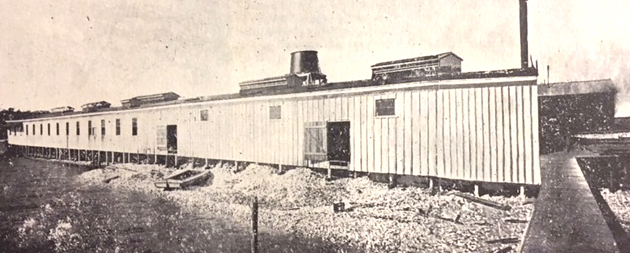
Barataria Canning Company
The initial incorporators in April 1885 of the Barataria Canning Company were primarily Jewish businessmen from New Orleans, Louisiana. Their large factory was situated on the Biloxi Channel near the end of Point Cadet. By 1891, Barataria was importing Bohemian families from Baltimore to supplement their local work force
Bohemians at Biloxi
Now there were numbers of Polish people and others who worked in vegetable factories in the North during summer months and were idle in the winter. These people were offered a job, which they accepted. A train was chartered which brought them to Biloxi. Now in order for the company [Lopez, Dunbars Sons & Company] to get back the cost of their transportation, little brass checks about one-half inch wide and 1-inch long were made. These checks were worth $.07 1/2 cents each. These imported people had a separate place [in the factory] fom the native people to weigh the oysters they shucked and the checks they would get were punched and worth only $.06 cents. This made them pay $.01 1/2 cents on each cup of oysters for their transportation. These checks were good only at their own places of business until that was outlawed and employees had to be paid in cash. From then on the difference was made up in the weight.[unpublished essay by Raymond Fournier (1876-1949), Mississippi Boundaries and its Seafood Industry on the Coast]
Polish Priest
The Reverend Father Buikski of Baltimore came to Biloxi during the 1904 Lenten season to hold special services in Polish for the Bohemian factory workers at Biloxi. The majority of these people were Roman Catholics and did not speak English.(The Biloxi Daily Herald, February 24, 1904, p. 5)
Bohemian School
The Barataria Mission School, also known as the Sabbath or Mission School, was a charitable, educational facility to educate children in the cannery camps on Point Cadet. It was overseen by Margaret Isabelle “Belle” Gordon (1862-1925) and Margaret “Maggie” Bowman Gordon Mass (1834-1907), her mother, and both were Presbyterians and native to New Orleans. The site for the school was provided by the Barataria Canning Company, a primarily Jewish owned cannery. The facility also taught night classes in reading, writing and arithmetic twice each week. In December 1903, the building needed a new roof, electric lights, and one volunteer to assist Miss Gordon. Mrs. Mass died at 1128 East Bayview Avenue, her home, in July 1907 and Belle Gordon died at Biloxi in May 1925.(The Biloxi Daily Herald, December 3, 1903, p. 6 and July 18, 1907, p. 1)
The Barataria Mission School was severely damaged by the hurricane of 27 September 1906. The replacement cost was estimated at $450 and the people of Point Cadet and the school staff worked diligently to raise money for the new building, a one-story, wood-framed structure, which was designed by Hugh H. Roof (1878-1969), an architect from Warren County, Ohio, who had just opened his Biloxi practice. The structure had dimensions of 25 feet by 40 feet. McCrary’s Cash Store held a benefit sale in late November 1906 to aid the school and the remainder of the funds were collected from generous donors and an Easter egg hunt and grab bag event held in the yard of Mr. Matthews. E.W. McCrary’s generosity must have been addictive as his confectionery store at Howard Avenue and Reynoir Street went into bankruptcy in late August 1909.(The Biloxi Daily Herald, September 27, 1906, November 24, 1906, p. 8, February 8, 1907, p. 1; March 7, 1907, p. 1; March 21, 1907, p. 1; and March 26, 1907, p. 1; and August 26, 1909, p. 4)
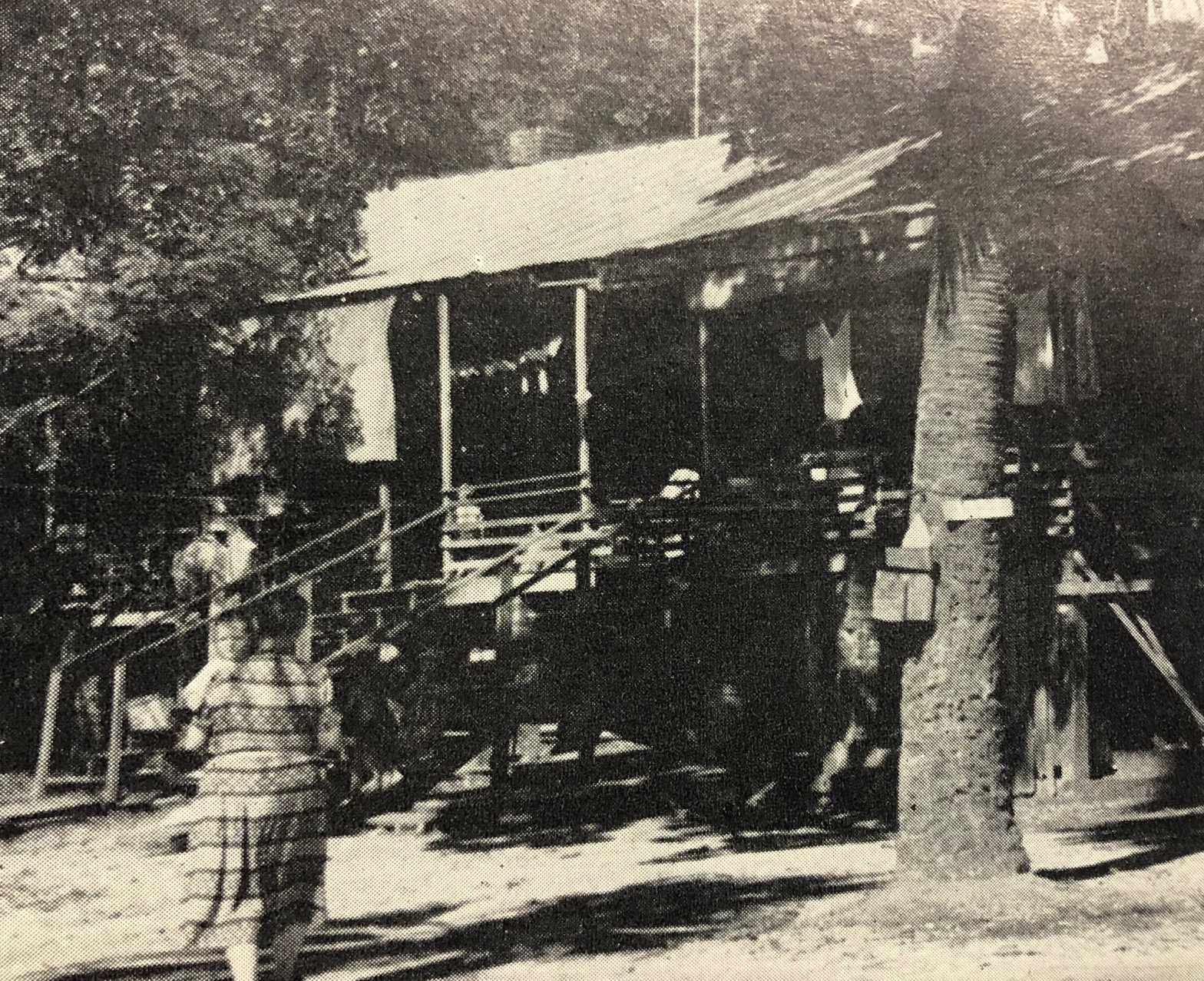
Seafood Camps
This vintage 1960s image of an east Biloxi seafood camp was situated on Point Cadet. Although the importation of seafood workers from Baltimore declined by 1920, camps like this existed at Biloxi until the late 20th century. I particularly remember the former Southern Shell neighborhood of shanties established for many of its workers on Back Bay. This venue is now the beautiful, oak-lined parking lot of the Boomtown Casino south of East Bayview Avenue opposite the gaming edifice. Menard's grocery store, the Fishermen's Hangout, Bruce's barbershop, and MaMa Lou's were other iconic structures in this area with several packing houses and small shipyards.
For those interested in the migrant cultures that influenced the seafood industry at Biloxi, the author highly recommends C. Paige Gutierrez’s The Cultural Legacy of Biloxi’s Seafood Industry [ca 1984]. Paige lucidly relates how the Bohemian, Croatian, Acadian French and later Vietnamese cultures were integrated into late 19th and 20th century Biloxi. This amalgamation created a blue collar, working class of people who were honest, primarily Roman Catholic, who reared large families and educated their children that prospered and became Biloxi’s doctors, lawyers and successful entrepreneurs. Kat Bergeron and Walter Fountain, both Biloxi journalist, have also written of her seafood industry and cultural relationships that defined it.
1891
On June 1, 1892, Lopez, Dunbar's Sons & Company acquired the Seacoast Oyster Packing Company. Seacoast was described as the largest and most complete establishment of its kind in the South.(The Biloxi Herald, June 20, 1891, p. 4)
The Barataria Canning Company completed their new plant on Point Cadet in July. It was 37,500 feet in area [750 long and 50 feet wide], which included living quarters for fifty families. The facility had a shrimp house, boiler house and coal shed, labor quarters, shucking house, and packing room. The factory at this time had about 600 employees with 400 working directly in the cannery and 200 on the water. The plant hoist had the capacity to lift 2000 barrels of oysters each day. The company board consisted of: Herman Rudolph Gogreve (1827-1899), president; Isidore Heidenheim, vice-president and secretary; H. Bentz, treasurer; August Heidenheim; and H. Aron. H. Edwards Jr. was plant superintendent.(The Biloxi Herald, July 11, 1891, p. 4)
The engine room of the Barataria Canning Company burned in early September 1891. Damage was estimated at $1000 and the plant was disabled for a few days.(The Biloxi Herald, September 12, 1891, p. 4)
The Bartaria Canning Company and Lopez, Dunbar's Sons & Company ceased to pack oysters until they could get a price competitive with the canneries on the eastern seaboard.(The Pascagoula Democrat-Star, December 18, 1891, p. 2)
1892
Pat Kennedy (1845-1913) established P. Kennedy & Company in November 1892 to engage in the business of shipping raw oysters.(The Biloxi Herald, November 12, 1892, p. 1)
1893
In April, John R. Harkness (1830-1903) was contracted by Lopez, Dunbar's Sons & Co. to construct a new, five thousand dollar, 18,000 square-ft.. cannery on the former site of the old one. Two-story, mansard towers on each end functioned as office space.(The Biloxi Herald, April 15, 1893, p. 1)
1894
The Biloxi Herald, January 20, 1894, p. 8.
In May 1894, the Hygeia Ice Works, built for $35,000 and owned by the De La Vergne Manufacturing Machine Company of New York, was operating at Biloxi west of the railroad depot. The plant had the capacity to make 15 tons of ice each day with Charles McCormack was their local representative.(The Biloxi Herald, May 19, 1894, p. 8)
1895
The price war between the Biloxi Artesian Ice Manufacturing Company and Hygeia Ice Works ended when the companies joined forces and formed the Biloxi Delivery Company with John McCormack as manager. The price of ice was set at $9 per ton and soon reduced to $7 per ton [50 cents per 100 pounds retailed] as customers complained.[The Biloxi Herald, July 20, 1895, p. 8]
Fayard & Dodart have perfected a method of preserving stock oysters in a healthy environment. They have built a pen connected th their wharf on front beach which allows a continuous flow of salt water over the captured mollusks.(The Biloxi Herald, August 24, 1895, p. 8)
1896
William Gorenflo (1844-1932) of Biloxi sold the Town of Ocean Springs 10,000 barrels of oyster shells to pave the streets of Ocean Springs. Jerry O'Keefe (1860-1911) bid $185 to do the work.(The Pascagoula Democratic-Star, November 27, 1896, p. 3 and The Biloxi Herald, November 28, 1896, p. 8)
1899
The Jackson County Board of Supervisors granted Adolph Ryan, William Seymour, H.H. Manuel, Louis G. Manuel, and Albert Tiblier the private right to plant oysters in the Back Bay of Biloxi.[The Pascagoula Democrat-Star, February 17, 1899, p. 2]
Herman R. Gogreve (1827-1899), president of the Barataria Canning Company, died at NOLA on 19 March 1899. He was a native of Bramsche, Germany and the husband of Caroline R. Schilling (d. 1903). Mr. Gogreve was a prominent businessman in the Crescent City and in addition to his seafood enterprise, he had interests in wholesale grocery sales; banking; insurance; and mining. Gogreve was a founder of the German Protestant Orphan Asylum and a member of the Audubon Park commission. The Gogreves resided on Broadway.(The Daily Picayune, March 20, 1899, p. 8)
In November 1899, Lopez & Dukate advertised for fifty boats to fish on the oyster banks and pay oystermen 40 cents per barrel of oyster. They would pay for fifty boats to transport oysters from the reef to the factory wharf for 40 to 50 cents per barrel. The factory also sought one hundred oyster shuckers. At this time Lopez & Dukate employed about 350 laborers in their oyster shucking operations. Wage for children and women ranged from 75 cents to $1.50 per day.(The Biloxi Daily Herald, November 10, 1899, p. 8 and November 19, 1899, p. 8)
1900-1910
1900
Captain James S. Wentzell (1857-1936) of the Lillie W. brought in 505 terrapins and 83 barrels of oysters. Each member of the crew sharing $85.70 for the 20 day trip.(The Biloxi Daily Herald, January 28, 1900, p. 8)
On February 9th, Governor Andrew H. Longino (1854-1942) appointed Harry T. Howard (1856-1930) and Walter A. White (1854-1942) of Biloxi; Eaton Jackson Bowers (1865-1939) and August Keller (1855-1907) of Bay St. Louis; and James Ira Ford (1862-1915) of Scranton [Pascagoula] to the Boundary Commission. The Boundary Commission was tasked with meeting with a similarly appointed body from Louisiana to attempt to determine a mutually acceptable marine boundary between the two states and mark it with buoys.(The Daily Picayune, February 10, 1901, p. 12)
At Neptune, Louisiana, near the mouth of the Mississippi River, Lopez & Dukate contracted with O.E. Thompson to erect a new factory building [100 feet by 100 feet] and a two-story, 12-room dwelling. By late February, Mr. Thompson was completing his work. In July 1900, the new company was incorporated in Plaquemines Parish, Louisiana as the Neptune Canning Company Limited with Laz Lopez, W.K.M. Dukate, Henry Lienhard and Dr. H.M. Folkes as primary stockholders.(The Biloxi Daily Herald, February 25, 1900, p. 8 and The Daily Picayune, July 17, 1900, p. 6)
Tax Assessments
Deer Island Fish Company
Lopez & Dukate-located at 1108 East Beach in 1905. [$26,000 tax assessment]
Barataria Canning Company [$10,400 tax assessment]
E.C. Joullian Packing Company [$12,000 tax assessment includes home of E.C. Joullian]
Biloxi Canning Company [$8500 tax assessment]
William Gorenflo and Company [$5000 tax assessment]
[see tax assessments The Biloxi Daily Herald, October 30, 1900, p. 8)
1901
The joint Boundary Commissions met at New Orleans on 26 March 1901. Here it was learned that those members of the Louisiana Oyster Commission had been named to serve also as commissioners of it Boundary Commission. Harry T. Howard of Biloxi was elected chairman and John Dymond Jr. (1866-1932) of New Orleans secretary for joint commission meetings. Secretary Dymond of the Louisiana Boundary Commission immediately made it clear that there was no boundary dispute with Mississippi. He confidently contended that the boundary had been established by the treaty with France for the 1803 Louisiana Purchase as the deep-water channel of the Pearl River flowing from its mouth out through the pass between Grand Island and Cat Island into the Gulf of Mexico. An engineer for the Louisiana commission added that the boundary described by Dymond had been surveyed and marked with buoys by the US Coast Survey. Chairman Howard corroborated this statement by relating that he had observed red and white buoys defining the channel.(The Biloxi Daily Herald, March 27, 1901, p. 1)
Bohemians-1901
In early May 1901, a special train was assembled at Biloxi composed of about five coaches and a baggage car to accommodate Bohemian workers from the Baltimore area who were returning home from their fall and winter work at the Lopez and Dukate cannery and from factories in Pass Christian. The oyster canning season had just ended on the Mississippi coast and these migrant workers were returning to work the summer at canneries on the east coast. They were expected to return in the fall for the next oyster season.(The Biloxi Daily Herald, May 5, 1901, p. 8)
1902
Bowers Oysters Bill-1902
The Mississippi Oyster Commission was organized in 1902, when the state legislature passed the Bower’s Oyster Bill of State Representative Eaton Jackson Bowers (1865-1939) of Bay St. Louis. The Oyster Commission was funded from the State treasury by an annual $12,000 appropriation and from revenues and taxes on certain items credited to the “Oyster Fund”. An integral part of the mission statement of the Mississippi Oyster Commission was to conserve and to replenish the State’s oyster reefs. By the spring of 1904, Chief oyster inspector, Robert Marion Mosely (1865-1910) was reporting that 23,000 barrel of shells had been planted in Biloxi’s Back Bay and 35,000 barrels planted between Deer Island and Ocean Springs. Bay St. Louis-Waveland reefs received 20,000 barrels of oyster shells and $1000 was spent on planting live oysters off the shore of Pascagoula. Recycled oyster shells were sold at the rate of 6 cents per barrel. The Bower's Bill became effective on 1 June 1902. It also prohibited use of steam or other dredges from harvesting oysters in Mississippi State waters. Only sail or hand powered watercraft could be used. Effective June 1, 1902. Passed House 94 votes for and 5 votes against and Senate 37 votes for and 4 votes against. Incipient oyster commissioners were: James “Buck” B. Chinn (1857-1912), Biloxi; John Duncan Minor (1863-1920), Ocean Springs; Ferdinand L. Patenotte (1867-1919), Pass Christian; Oscar T. Cassibry (1850-1933), Gulfport; and F.J. Ladner, Bay St. Louis. (The Biloxi Daily Herald,February 6, 1902, p. 1; April 20, 1903, p. 6; March 25, 1904, p. 5 and June 22, 1904, p. 1)
Introduced into the Mississippi Legislature by Representative Eaton Jackson Bowers (1865-1939) of Bay St. Louis to prohibited use of steam or other dredges from harvesting oysters in Mississippi State waters. Only sail or hand powered watercraft could be used. Effective June 1, 1902. Passed House 94 votes for and 5 votes against and Senate 37 votes for and four votes against.(The Biloxi Daily Herald, February 6, 1902, p. 1)
Lopez & Dukate Cannery
In July 1902, Lopez & Dukate contracted with Ola (sic) Thompson (1874-1944) to build a large oyster cannery, house, store, warehouse, and Bohemian camp at the [Blind] Rigolets in southeast Louisiana. (The Biloxi Daily Herald, July 16, 1902, p.8)
In September 1902 G.W. Dunbar’s & Sons were planning to erect a cannery at English Lookout in St. Tammany Parish, Louisiana. Charles Sanger was the contractor. The Dunbars planned to move canning equipment from their Bay St. Louis plant to the new location where they would pack only bi-valves harvested in Louisiana. The Bay St. Louis factory would process only oysters taken from Mississippi waters.(The Biloxi Daily Herald, September 22, 1902, p. 1)
State Oyster Commission
September 1902-The Mississippi State Oyster Commission was organized on September 1st. Robert M. Mosley (1865-1910), former Biloxi marshal, was the first Chief Oyster inspector until his demise on November 21, 1910.
A joint session of the Louisiana and Mississippi Oyster Commissions met in the office of attorney John Dymond Jr. at New Orleans on September 9, 1902. No agreement was reached as to the disputed territory along the boundary line between the two states. An understanding between the two parties was agreed upon until the settlement of the suit pending in the US Supreme Court concerning the Mississippi-Louisiana boundary line was determined. This agreement created became known as the Neutral Ground and it defined a common fishing ground for the fishermen of both Mississippi and Louisiana as follows: Beginning at a point in the center of the mouth of the Pearl River, thence in a southeasterly direction to Malheureux Point, thence in an easterly direction following the shoreline to Grass Pass [sic], thence along the shoreline of Grand Pass, thence easterly to the southern most point of Sundown Island, thence northeasterly to the center of the deep water channel called Cat Island Channel, thence following said deep water channel westerly passing between Grassy Island and the St. Joseph Lighthouse to the point of beginning.(The Daily Picayune, September 10, 1902, p. 6)
1903
Suit for Damages
Captain N.E. Skinner, master of the Emma Harvey, has filed suit in Federal Court [probably Chancery Court] seeking $250 and court cost against George Terry, president fo the Oystermen's Protective Association, Matt Cox, Allen Everett, John Poulton, Gus Fountain and Eddie Wentzell for alleged intimidation of the crew of the Emma Harvey, a shrimp boat, [working] in the [Louisiana] marsh and manned by Captain Skinner and crew: Marion Stafford, Bud Chatham, John Spinley, and John Lawson. The crew of the Emma Harvey was unloading shrimp onto the Wade Hampton, an ice boat, sent to Brush Island by the Barataria Canning Company of Biloxi.(The Biloxi Daily Herald, September 28, 1902, p. 6 and Harrison Co., Mississippi Chancery Court Case No. 1662-November 1903)
N.E. Skinner v. George Terry, et al, Harrison Co., Mississippi Chancery Court Cause No. 1662.
In September 1903, Captain N.E. Skinner, captain and master of the Emma Harvey, was unloading shrimp into the Wade Hampton, an ice-boat, sent to Brush Island by the Barataria Canning Company. George Terry, Matt Cox, Allen Everett, John Poulton, Eddie Wentzel and Gus Fountain threatened the Emma Harvey's crew for selling seafood to the Barataria Canning Company. George Terry was president of the Osytermen's Protective Association, an organization founded to protect and promote the interests of the laboring class. Case dismissed April 1907.
1904
Oyster legislation-In February 1904, Evon M. Barber (1858-1921), of Biloxi and representing Harrison County, attempted to introduce legislation in the State House of Representatives via the Fisheries Committee to deny the right of anyone not a Mississippi resident to fish on public oyster reefs. This law directly targeted the Bohemian migrant worker from Baltimore. Mr. Barber, an attorney, also represented the Oystermen’s Protective Association.(The Biloxi Daily Herald, February 20, 1904, p. 4 , February 29, 1904, p. 2, and March 4, 1904, p. 2)
Shrimp prices
Shrimp prices from the Louisiana marsh soared from $2.50 per barrel to up to $5.00 per barrel when Dunbar's factory raised the price. Lopez & Dukate followed suit. When word reached the marsh that the price was reduced over one hundred boats left for Biloxi, the fleet resembling a large sailing regatta. Biloxi fishermen from the marsh related that they could not pay food bills and make a living when shrimp are scare as they were this season and the price was only $2.50 per barrel or less.(The Biloxi Daily Herald, October 3, 1904, p. 1)
Oyster shipment
900 barrels of unculled Alabama oysters were shipped to a cannery at Mississippi City for processing. This was the first Alabama oyster received.(The Biloxi Daily Herald, October 20, 1904, p. 5)
Oyster tax revenues
The State expected to received over $22,000 in tax revenues from local canners in the 1904-1905 season. There was an oyster boat license fee and each barrel of raw oysters was taxed 2 and 1/2 cent.
(The Biloxi Daily Herald, October 22, 1904, p. 5)
Oyster opener wages
An oyster opener was paid 7 1/2 cents per 100 oysters opened. A skilled laborer could earn between $5 and $6 per day. An exceptional worker could open as many as 8000 oysters daily.The Biloxi Daily Herald,
December 27, 1904, p. 5)
Philip McCabe (1837-1904), native of New Orleans and first chief engineer of the Biloxi Volunteer Fire Company, expired in mid-December. In their youth, Ed Glennan and Charles Redding both worked for Mr. McCabe at NOLA when he had a stove business on Camp Street in NOLA. McCabe also was the first tin can manufacturer on the Coast making fruit, oyster, and vegetable cans.(The Pascagoula Democrat-Star, October 28, 1881, p. 3 and The Biloxi Daily Herald, December 16, 1904, p. 5)
1905
New E.C. Jouillian factory-planned to operate a factory on the Mississippi River [Violet] near the mouth of the Lake Borgne Canal known as Borgnemouth. Factory to handle 1000 barrels of oysters per day and situated on the west or upper side of the canal. Oysters will be transported through the canal and from the Mississippi River from the oyster districts of two parishes.(The Daily Picayune, January 24, 1905, p. 5 and The Biloxi Daily Herald, January 31, 1905, p. 5)
Oyster conviction-Madison Cox (1877-1914), Charles Palmer (1848-1922), and Albert Desporte aboard North American were caught and fined $150 in St. Bernard Parish, Louisiana for unlawfully catching oysters in Louisiana State waters. In violation of La. Act 52-1904.(The Biloxi Daily Herald, February 10, 1905, p. 6 and February 11, 1905, p. 4)
Barataria Canning Company-installed a switch to connect the end of the Biloxi Electric Railway & Power Co. track with its canning plant, shell crusher, and elevator to allow loading shells and canned goods directly and save drayage expenses.(The Biloxi Daily Herald, February 24, 1905, p. 5)
Oyster leader- According to published figures gathered by the Census Bureau of the Department of Commerce and Labor recently published in the Fishing Gazette [New York], Biloxi in 1905, led the nation in the value of its canned oysters worth $1,502, 497. The other leading states at this time were: South Carolina-$568,239; Louisiana- $506,325; and Georgia-$256,750. Biloxi's oyster industry sold $1,340,942 worth of canned oysters in 1904 and only $569,000 in 1900.(The Biloxi Daily Herald, April 23, 1907, p. 1)
Lopez & Dukate-contracted with T.J. Rosell Manufacturing Company to erect a Catholic Church costing $1500 at the Rigolets for their cannery workers.(The Biloxi Daily Herald, November 20, 1905, p. 1)
1906
Oyster legislation-Evon M. Barber (1858-1920+), State Representative from Harrison County and attorney for the Oystermen's Association, introduced a bill in the House to amend the Bower's Bill of 1900.(The Biloxi Daily Herald, January 5, 1906, p. 4)
In October 1905, Attorney Generals from Louisiana and Mississippi argued the boundary line case at the US Supreme Court in Washington D.C. On March 5, 1906, Chief Justice Fuller (1833-1910) of the Court ruled in favor of Louisiana on the water boundary dispute known as Louisiana v. Mississippi US 58 [1906]. The 300 square miles of territory in dispute including oyster grounds valued at a minimum of $5 million dollars slipped from the hands of eager cannery magnates in Biloxi and other Mississippi coast cities.(The Biloxi Daily Herald, March 6, 1906, p. 1 and The Daily Picayune, March 6, 1906, p. 4)
The Consumers Fish and Oyster Company was chartered by W.H. Bouslog; N.J. Beane; Edward Glennan; Joseph Rush; and J.A. Broadus.(The Biloxi Daily Herald, August 25, 1906, p. 2)
The Kennedy-Lopez Oyster and Fish Company acquired at auction for $2000 the assets of the Treasure Bay Oyster Company in New Orleans. They planned using the facility in their raw oyster business as the plant at the Rigolets.(The Biloxi Daily Herald, September 15, 1906, p.4)
In October 1906, boundary representatives from Louisiana and Mississippi convened in Jackson, Mississippi to plan the marking procedure for the state boundary designated by the US Supreme Court. It was established that 36 buoys would be utilized with one placed every mile. The estimated cost was $8000 and Governor James K. Vardaman (1861-1930) of Mississippi related that his state had no money for the project.(The Biloxi Daily Herald, October 13, 1906, p. 4)
1907
1907-Captain John S. Mavar (1880-1960) aboard Electricity, a schooner owned by Lopez & Dukate, was caught poaching oysters in St. Bernard Parish, Louisiana in mid-April. He pleaded guilty and his crew of Simon Mavar, Simon Mavar Jr. and John Matozich was released. Bond was set at $300 and the authorities in St. Bernard Parish wanted the schooner forfeited as part of the penalty for having six barrels of Louisiana oysters.(The New Orleans Item, April 14, 1907, p. 2, April 16, 1907, p. 12, and May 7, 1907, p. 1)
Lopez & Dukate acquired a location near the Company Canal at Westwego, Louisiana for the erection of a shrimp cannery. A large number of local people will be employed.(The New Orleans Item, May 6, 1907, p. 1)
Lopez & Dukate-Sent Captain Fred Eaton aboard Tom, a large power boat, to Morgan City, Louisiana in late June 1907 to open a canning factory.(The Biloxi Daily Herald, June 29, 1907, p. 5)
1907-A violent storm in late September hit the Louisiana marsh with winds from the northeast of up to 80 mph and inflicted damage on some of the Biloxi fishing fleet operating here. The Dauntless owned by Louis Gorenflo and captained by James Ryan went aground in the marshland with the Dorenza of Henry Diaz and under the commande of James Lamey and the William Coates owned and sailed by Tony Rosetti. Boats either cutting or losing masts were the Elbert D of Lopez & Dukate and Jolly Traveller owned by Willie Bullock and under contract to the Barataria Canning Company. Barataria's other boats in the marsh, Henry M., Nels Johnson, and Indian Girl, were slighly damaged. Lopez & Dukate had its Wilda L. run aground on Martin Island while their Ola D. and Noreta L. were relatively unscathed by the tempest.(The Biloxi Daily Herald, September 30, 1907, p. 1)
By August 1907, the Louisiana Oyster Commission had determined that the state boundary with Mississippi would need 28 spar buoys to delineate it. In late September the Louisiana Oyster Commission had placed in service the New Orleans, an armed, patrol boat, formerly the yacht of Dr. Ralph A. Tudery (1871-1950), which they had acquired for $7500. The New Orleans had a 55 hp engine and could cruise at 10 mph while guarding the oyster beds in Lake Borgne.(The Daily Picayune, August 22, 1907, p. 5
1908
Shrimp-Biloxi fishermen could expect to be paid $3.50 per barrel of shrimp.(The Biloxi Daily Herald, March 31, 1908, p. 1)
Oysters-Salvador Taranto (1881-19 ) was vending 'famous Deer Island' oysters at his business at 701 West Howard Avenue in October 1908. The oysters sold for 10 cents a dozen on ice with all condiments provided. Taranto also sold the fienst fruits and vegetables.(The Biloxi Daily Herald, October 3, 1908, p. 8)
Dunbars, Lopez, and Dukate Company was organized at NOLA on September 8, 1908. In December 1908, the new organization had to face the Louisiana commissioner to defend charges that they were paying more for oysters in Mississippi than in Louisiana. The company had canneries at Dunbar, Louisiana and at the Rigolets. Name changed to Dunbar-Dukate Co. Inc. in September 1915.(The Daily Herald, December 8, 1908, p. 1 and October 14, 1915, p. 2)
New oyster law-Louisiana's legislature passed an onerous statue that dictated that oysters had to be shipped in barrels and not in sacks. About 3000 oystermen went on strike to protest the law. (The Biloxi Daily Herald, July 27, 1908, p. 1)
1909
The Lopez-Greiner Packing Company of Julius M. Lopez and Charles Forrester Greiner [1874-1946] was incorporated and domiciled in Biloxi, Mississippi to pack or can crabs, crab meat, shrimp, and other seafoods; also canning fruits, vegetables or syrups. Also the buying, selling and dealing generally in oysters, fish and other sea products. $25,000 in capital stock valued at $100 per share.[The Daily Herald, May 8, 1909, p. 3]
1910-1920
1910
Kennedy-Lopez closed its plant at the Rigolets and opened a factory on the Biloxi beach front at Delauney Street. They planned to operate their boats in the Louisiana marsh and bring opened oysters to Biloxi for processing.(The Daily Herald, July 11, 1910, p. 8)
Gasoline boat burns-The Harry Cage, a sixty-foot, gasoline freighter owned by Dunbar, Lopez & Dukate burned ten miles southeast of Chandeleur Island in early September 1910.(The Ocean Springs News, September 10, 1910, p. 1)
Ulysse Desporte (1861-1927) who began his career in the packing industry circa 1894, sold his shrimp and oyster factory in October 1910 to the Kennedy-Lopez Company and for $10,500 reacquired it in November 1910 for $15,500. Laz Lopez made an offer to Desporte in December 1910 for his plant, site and boats for $25,000.(The Ocean Springs News, October 15, 1910, p. 1 and The Daily Herald, November 14, 1910, p. 8 and December 6, 1910, p. 8)
The Barataria Canning Company stated that they had no desire to get into litigation with the Alabama oyster commission over their purchase of oysters from Alabama water bottoms.
(The Daily Herald, November 15, 1910, p. 1)
In December, The Kennedy-Lopez Company was sued by two parties: F.W. Elmer who resided on Front Street north of the plant which was just west of Lameuse Street and a group represented by: J.H. Miller; Edward Glennan; Mrs. L. Holley; Harry T. Howard, et al. The plantiffs argued that the oyster factory created an oderous and unhealty situation for their hotel guests and the neighborhood.[The Daily Herald, December 18, 1910, p. 1 and p. 4]
Laz Lopez resigned as manager of Dunbar, Lopez & Dukate effective January 1, 1911. He was replaced by William F. Gorenflo, a founder and icon of the Biloxi canning seafood industry. Mr. Lopez acquired the Ulysse Desporte cannery on the Front Beach just west of Lameuse Street.(The Daily Herald, December 29, 1910, p. 8)
1911
Barataria Company Canning experimenting with glass container to pack shrimp.[The Daily Herald, April 18, 1911, p. 8]
In July, the Lopez-Greiner Packing Company was organized in St. Bernard Parish, Louisiana. Company officers were: Lazaro Lopez, pres.; Julius Lopez, v. pres.; Charles F. Greiner, sec. and treasurer; Arnaud Lopez, Martin Nunez, and Hugh B. Rush-Board of Directors. The plant was situated on the Martin Nunez tract on Delacroix Island in Plaquemines Parish, Louisiana.[The New Orleans Item, July 7, 1911, p. 6]
In August, the Lopez-Desporte Packing Company was organized in St. Bernard Parish, Louisiana. Company officers were: Arnaud Lopez, pres.; Ulysses Desporte, v. pres.; Hugh B. Rush, sec. and treasurer; Julius M. Lopez, Lazaro Lopez, and Charles F. Greiner-Board of Directors.[The Daily Herald, August 7, 1911, p. 1]
Imperial Packing Company- The Imperial Packing Company was commenced by Jeff D. Mulholland (1861-1930) when he purchased a site in North Biloxi with 200-feet on the Back Bay of Biloxi from his mother-in-law, Rosina Hosli Harvey (1852-1937). Imperial opened in August 1911 with a work force of 100-120 laborers and with lots of shrimp to pick by hand.(The Daily Herald, August 28, 1911, p. 4)
Raw oyster shippers at Biloxi: Lopez & Dukate, Wentzell Brothers, Kennedy-Lopez Company, Henry Diaz & Company, and the Biloxi Fish & Oyster Company [Gorenflo] were under duress by the L&N Railroad. The L&N Railroad who rented cars to the express company, the carrier of perishable items, had restricted the loading time at their stops to 5 minutes. This caused most large oyster shipments to not be completely loaded onto the express cars creating a hugh fianacial loss for Biloxi's local oyster shippers. The Commercial Club contacted the Raillroad Commission to halt this destructive practice to the local oyster trade.(The Daily Herald, December 22, 1911, p. 1)
1912
The firm of Ott Brothers & McCaleb, raw oyster shippers on Point Cadet, had a successful season. The firm ships directly to hotels and restaurants in large American cities.[The Daily Herald, March 7, 1912, p. 8]
Kennedy-Lopez Oyster & Fish Co. is operating its oyster business at the Rigolets, Louisiana and its shrimp canning at Biloxi. They have shipped as many as 350,000 oysters in one day. 50 shuckers and employ about 75-100 people. Two large gas dredge boats are kept busy and they also have 4-5 schooners and 10-15 independent vessels cathcing oysters.They will make a specialty of headless and canne shrimp this season. William P. Kennedy is president and John J. Kennedy, a brother is an officer. George W. Grayson is general manager, a former representative of the L&N Railroad.[The Daily Herald, March 12, 1912, p. 8]
Bourdon and Castenara Packing Company named Ulysses Desporte as manager in April.(The Daily Herald, April 5, 1912, p. 8)
C-1 and August 12, 1994, p. B-1] [posted 29 January 2026]
S.P. Richardson [NOLA] has leased a part of the former E.C. Joullian Canning Company tract from Martin Fountain. He plans to commence processing raw oysters. The lease is for one year with an option for five years. The plant is being refurbished, and oystermen have been contacted to provide mollusks from the oyster grounds.[The Daily Herald, September 5, 1912, p. 8]
Kennedy-Lopez opened a large plant at NOLA on the Old Basin Canal in the former New Orleans Light & Power Company structure. The company planned to supply Texas and points west. In addition, freight rate expenses were cheaper and the $.03 cent tax per barrel paid to export Louisiana oysters to Mississippi were eliminated as well as the $.02 cent tax charged in Mississippi. Walter Hodgins, manager, with William P. Kennedy overall supervisor of operations.[The Daily Herald, October 29, 1912, p. 1]
Biloxi raw oyster shippers sent by railroad express about 930 cases [about 800,000 oysters] of raw oysters to Louisiana, Texas, Alabama and Tennessee. A case is estimated to contain about 800 oysters. The oysters were all harvested from Louisiana reefs. [The Daily Herald, October 29, 1912, p. 1]
The Chancery Court of Harrison Co., Mississippi ordered that the Dunbars, Lopez, and Dukate Company be dissolved and pay a $10,000 fine for anti-trust violations. Any member of the limited co-partnership could buy or operate any of the packing plants or sell them to an independent corporation. The ruling resulted from Cause No. 3202, "Wirt Adams, State Revenue Agent, St. of Mississippi v. W.K.M. Dukate et al" filed in 1910. Went to Mississippi Supreme Court in May 1912 who ruled against the packers.(The Daily Herald, May 7, 1912, p. 1, November 7, 1912, p. 1, and p. 8)
Kennedy-Lopez Oyster & Fish Company plant at the Rigolets was destroyed by fire on Christmas Day 1912. They did not operate in 1912.(The Daily Herald, December 26, 1912, p. 4)
1913
Isidore Heidenheim is receiving bids for materials, supplies and labor the building of the Sea Food Company.The Seafood Company of Biloxi-founded by H.E. Gumbel and Isidore Heidenheim.[The Daily Herald, May 12, 1913, p. 5]
A new cannery was being built in the late spring of 1913 near the former E.C. Joullian plant on Back Bay. Martin Fountain was a principal owner and C.B. Foster the manager of the new venture. Two building nearing completion[50 x60] [40x60]. Machinery will be installed and factory ready for the fall shrimp season.[The Daily Herald, June 12, 1913, p. 8]
The Foster-Fountain Company was chartered in St. Bernard Parish, Louisiana in late June 1913, with the following officers: Martin Fountain Jr. (1882-1963)-president; Louis V. Trochessett (1876-1933), vice-president; and Charles B. Foster (1877-1931) sec.-treasurer. The Board of Directors was composed of: Martin Fountain Sr. (1856-1938); Martin Fountain Jr.; Louis V. Trochessett; Charles B. Foster; and William H. Foster (1876-). Located at 278 East Back Bay in 1922.(The Times-Picayune, June 28, 1913, p. 13)
Arthur Yancey filed a Federal injunction at NOLA against the Biloxi Canning Company, Bourdon-Castanera Packing Company, Dunbars, Lopez and Dukate Company, Kennedy-Lopez Company, Desporte-Lopez Company, and the Peerless Packing Company [Bay St. Louis] for patent encroachment of his seine patent.[The Daily Herald, July 15, 1913, p. 2]
Dunbars, Lopez & Dukate began canning oysters at its Westwego plant. A track is being constructed to facilitate the handling of cars of bivalves. Since the oyster season begins after the shrimp season, seafood workers can expect to continuous work. Modern equipment is being installed.(The Times-Picayune, December 18, 1913, p. 5)
1914
Devitt & Clark-incorporated on June 10, 1914, at New Orleans.( Harrison County, MississippiCharter Book ? , pp. ) The Officers of Devitt & Clark were Thomas Kirkland Devitt (1882-1946),president; Charles C. Redding (1857-1926), vice president; and Patrick Henry Clark (1870-1927), secretary-treasurer. Charles W. Mackie, Jr. was a stockholder and on the board of directors of the firm.
Biloxi packers cut the price of oysters at the reef from $.40 per barrel to $.30 per barrel. The Rugge Brothers from Appalachicola, Florida were at Biloxi offering jobs to Biloxi fishermen.(The Daily Herald, January 6, 1914, p. 1)
Henry Diaz (1872-1944), leading fish and oyster dealer, is moving his plant from Reynoir Street to a position on Reynoir and Back Bay on the shell pile. The new and modern plant will be housed in a building near Mr. Diaz's store.(The daily Herald, June 4, 1914, p. 2)
W.F. Gorenflo, recently retired from general manager of Dunbars, Lopez & Dukate, has returned to Biloxi from Brunswick, Georgia. He arranged for a large oyster cannery to be erected there to rival in size the largest in Mississippi. He will associate with W.K.M. Dukate, as well as other Biloxi investors in the Georgia venture. I. Heidenheim of the Sea Food Company is also in Brunswick seeking to commence seafood processing. [The New Orleans Item, June 17, 1914]
Elizabeth Watson, social worker, reported for New York and eastern journals that working conditions in Biloxi's seafood industry were poor. Allegations denied by W.K.M Dukate.(The Daily Herald, June 29, 1914, p. 1)
Imperial Packing Company, canners of oysters and figs in North Biloxi, at a meeting in early August listed its officers as: W.R. Carter, pres.; Laz Quave, vice pres.; Sec.-Treas., T.H. Gleason; Board of Directors: Isom Brasher; Casimir 'Boy' Harvey Jr.; J.H. Johnson; W.S. McIntyre; Matt Moran; Laz Quave; Peter Quave; H.P. Rushing; and Adolph Santa Cruz.(The Daily Herald, August 7, 1914, p. 5)
1915
In the late summer, the seafood undustry at Biloxi was idled for about a month by a strike of the International Longshoremen's Association. The Seafood Company sent out the most boats to catch shrimp after the strike. In late July, Arthur Goula, a non-union seaman, shot and wounded John Simmons, a union member and employee of Foster-Fountain.(The Daily Herald, September 1, 1915, p. 1, September 3, 1915, p. 1 and September 23, 1915, p. 1)
Dunbars, Lopez and Dukate Company-in October 1915, the Dunbars, Lopez and Dukate Company changed its name to the Dunbar-Dukate Company. Newly elected officers of the company were: George H.Dunbar (1844-1917), president; W.K.M. Dukate (1852-1916), vice-president; Elbert L. Dukate (1881-1943), secretary; and James V. Dunbar, treasurer. At this time, the company was heavily engaged in repairing their plant, boats, and other properties related to their seafood operation, which had been lost or damaged in the recent hurricane. By November 1, 1915, operations at the packing plant were anticipated to commence on the oyster catch.(The Daily Herald, October 14, 1915, p. 2)
The J.S. [sic] Wentzell Sr. (1879-1927), wholesale fish and oyster dealer of the Wentzel Brothers, acquired about 2000 feet of land fronting on the north side of Deer Island from the Deer Island Improvement Company. The deal was closed by George W. Grayson and included lots, oyster beds, and riparian rights. The Wentzell tract ran from the baseball park westward. Mr. Wentzell planned to erect a bungalow on the property.(The Daily Herald, October 20, 1915, p. 1)
1916
George Terry & Son, raw oyster shippers, have acquired a tract on Point Cadet and plan to erect a large shrimp and oyster cannery. It will be equipped with modern machjinery and ready for the spring shrimp season.(The Times-Picayune, January 31, 1916, p. 13)
In August, C.B. Foster, former manager for Fountain-Foster, took a lease on the former Gorenflo plant and camp on Back Bay and Main Street, which had shut down about four years past. The Fountain Brothers and Louis V. Trochesett would continue their packing operations also on Back Bay. Mr. Foster had modern canning equipment installed and awaited the coming shrimp season. Biloxi had about 11 seafood cannning operations at this time.[The Daily Herald, August 5, 1916, p. 2]
Charles B. Foster and Company-founded by Charles B. Foster (1877-1931), W.H. 'Henry' Foster, and E.J. Ford. Charter applied for in August 1916 for Biloxi, Mississippi and Violet, St. Bernard Parish, Louisiana.(Harrison Co., Mississippi Chattel Bk. 18, p. 379)
C.B. Foster and Company located at 224 East Back Bay in 1922. In September 1935, the Peoples' Bank of Biloxi sold the property to Southern Shell Fish Company, a subsidiary of the Wesson Oil Company. The sale included: the factory; eight boats; shipyard; labor camp, which was composed of forty-nine homes; a store; and warehouse. Chester August Delacruz (1889-1964) was secretary of the C.B. Foster Packing Company from 1916 to 1931 and president until 1933 when he took over the reins of the Biloxi Oyster Exchange. In 1935, he became local manager of the Southern Shell Fish Company on Back Bay. Chester Louis Delacruz (1911-1996), his son, succeeded his as manager until his retirement in 1976.(Harrison Co., Mississippi Chancery Court Charter Bk. 16, p. 284 and The Jackson County Times, September 14, 1935, p. 1 and The Sun Herald, July 8, 1996, p. C2 and see also Harrison Co., Ms. Chancery Court Cause No. 14013, Biloxi Oyster Shell Grit Co. v. C.B. Foster Packing. Co.)
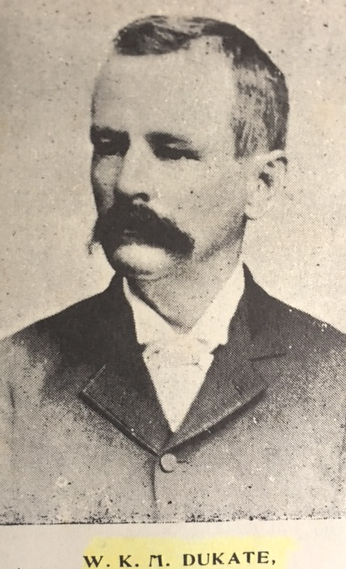
William K.M. Dukate (1852-1916), native of Fredericksburg, Indiana and Biloxi seafood magnate and entrepreneur, expired at his Biloxi home on March 29th.(The Daily Herald, March 29, 1916, p. 1)
Fisherman’s Packing Company-chartered by the Fisherman's Co-Operative Union in June 1916 by William Estopinal of Gulfport; and Albert Anderson, Peter Paker, John Jeluisich, Armond Lepre, Jack Rosetti, Octave Trochesett, and Nick Skrmetti of Biloxi; and Walter Switzer of Handsboro. (The Daily Herald, May 9, 1916, p. 1 and Harrison Co., Mississippi Chattel Bk. 16, p. 197)
1917
Quave Seafood-Construction commenced in June 1917, by Peter Quave (1863-1936), who had managed the Imperial Packing Company. Workers were working feverously to had the cannery in operation for the shrimp season which opened in August. Although not a large plant, the Quave factory was anticipated to have a beneficial affect on the local economy.(The Daily Herald, June 7, 1917, p. 3)
George Hacker Dunbar (1844-1917), inventor of an 1876 shrimp packing process that allowed the product to retain its freshness, color and flavor, expired at New Orleans on October 18th.(The New Orleans Item, October 19, 1917, p. 11)
1918
In mid-January, a gale in the Mississippi Sound resulted in the deaths of two, colored seamen who drowned from the Farewell, owned by the Seafood Company. Captain Edward Parker, also colored, and master of the fishing vessel, was rescued. The Josephine Lopez and Algonquin working for Dunbar-Dukate were driven ashore on Cat Island with 800 barrels of oysters on board.(The Daily Herald, january 16, 1918, p. 1)
Captain Ernest Desporte Sr. (1853-1931) proposed that a bounty be offered to oystermen to destroy the conch. The conch population on local oyster reefs had reached proportions that endangered the very existence of the local oyster industry.(The Daily Herald, February 8, 1918, p. 3)
Devitt-Clark Packing Company took a $25,000 mortgage from Charles Redding and listed their fishing boats as follows: Schooners: Joe Lawrence; Ocean Queen; Henry Clark; and Lilly Rose. Barge: Black Box; Motor Boats: Sunny Boy; Zuzudora; Hunter; Cuba; and Cracker Jack; Trawlers: No. 1 thru No. 5; Skiffs-fifteen and nine large seines.(The Daily Herald, April 23, 1918, p. 5)
Loren Keel and Henry Gorenflo purchased the Biloxi Fish & Oyster Company. It was formerly operated by Louis Gorenflo.(The Daily Herald, December 3, 1918, p. 3)
1919
The Mississippi Fish and Oysters Dealer's Association was founded at Biloxi in August 1919 to promote the fish and oyster business at Biloxi and other Coast cities and to secure the highest market value for the seafood of its membership. George Terry, president; W.W. Dywer, vice-president; and Ernest Desporte Jr.-sec.-treasurer.(The Times-Picayune, August 1, 1919, p. 12)
The Daily Herald announced on September 23, 1919 that in the past six months the following canneries were initiated at Biloxi: Lopez Canning Company; Desporte Brothers Canning Company; Imperial Canning Company; Fisherman's Packing Company; Southern Fish & Shrimp Company; Biloxi Fisheries, Inc. and Elmer & Spottswood Canning Company-located at Back Bay and the foot of Lee Street in 1922. It burned in late January 1928, when leased to the Ocean Springs Packing Company of Louis A. Lundy and Joseph Zaehringer. The Ocean Springs Packing Company lost more than 1700 cases of fresh canned shrimp.(The Daily Herald, September 23, 1919, p.3 and The Jackson County Times, February 4, 1928, p. 1) )
Biloxi Fisheries Inc.
Desporte Brothers-founded by Theodore J. Desporte and Ernest Desporte Jr. located at 335 East Back Bay.
Elmer & Spottswood Canning Company-located at Back Bay and the foot of Lee Street in 1922.
Burned in late January 1928, when leased to the Ocean Springs Packing Company of Louis A. Lundy and
Joseph Zaehringer. The Ocean Springs Packing Company lost more than 1700 cases of fresh canned shrimp.
(The Jackson County Times, February 4, 1928, p. 1)
Lopez Canning Company
Southern Fish & Shrimp Company-
Gulf City Packing Company-located at 1326 East Beach
Latimer Packing Company-located at 113 East Back Bay
R.S. Russ Packing Company-located at 127 East Back Bay
1920-1930
1920
Dudley Read, moving picture operator for two of the leading talking movie corporations of America, was in Biloxi making moving pictures of the oysters industry.(The Daily Herald, April 22, 1920. p. 1)
The Biloxi Packing & Trading Company was incorporated on September 20, 1920 at New Orleans,
Louisiana. W.H. Anticich was president and Grego Anticich (1886-1954), secretary. Other principals were: Mary Skrmetta Anticich, Jake Rosetti, John Mavar, John Skrmetta, Vincent Rosetti, Mike Kulivan (1875-1944), Frank Bosarge, and Vlocho Milion.(MOB, 1246, p. 286 and The Daily Herald, September 19, 1920, p. 4)
C.B. Foster has machinery on site to erect an oyster shell grinding plant. The ground shells will be used in the manutacturing of fertilzer and additional products.[The Times-Picayune, October 10, 1920, p. 7]
Major Biloxi canners for the first time decided not to seek Bohemians from Baltimore to work during the oyster season. The railroads had increased the fare to the Coast from $12 to $48 per person which was also applicable to children over the age of 12 years. Younger children were charged half fare. In order to ameliorate the situation additional laborers would be sought in the local community. In addition, workers of French ancestry from south Louisiana would be sought as some had already proven themselves in Coast canneries.[The Daily Herald, October 8, 1920, p. 1]
C.B. Foster has machinery on site to erect an oyster shell grinding plant. The ground shells will be used in the manutacturing of fertilzer and additional products.[The Times-Picayune, October 10, 1920, Section 4, p. 14]
L.H. Manuel, Biloxi contractor, will start a canning plant for Latimer & Clark at Bayou LaBatre, Alabama. Shrimp will initially be packed.[The Times-Picayune, October 10, 1920, Section 4, p. 14]
C.B. Foster Packing Company Inc. domiciled at Violet in St. Bernard Parish, Louisiana to can seafood, fruits and vegetables. Officers: C.B. Foster, pres.; W.H. Foster, vice-pres.; Mamie F. Ford, treasurer; Chester Delacruz, secretary. Directors: C.B. Foster, W.H. Foster, Mamie F. Ford, E.J. Ford and Chester Delacruz.[The New Orleans State, October 12, 1920, p. 7]
1921
Captain Lindenberg aboard Madeline returned to Biloxi with 20,000 pounds of red snapper caught on the Campeche Bank off the coast of Mexico. The vessel was fishing for Biloxi Fisheries Inc. and the catch was to be shipped to Eastern markets.(The Daily Herald, January 1, 1921, p. 3)
The Biloxi Fish & Oyster Company, a partnership formed by Henry Gorenflo (1848-1923) and Loren M. Keel, was dissolved on July 14, 1921.(The Daily Herald, September 21, 1921, p. 3)
The Southern Canners Association was formed at Biloxi on October 17, 1921, when cannery operators from the South Atlantic and Gulf States united. Dr. L.H. Jastremski was named permanent president and Ernest Desporte Jr. of Biloxi treasurer. Vice-presidents were: Edward E. Elmer, Mississippi; Charles Greiner, Louisiana; Charles Clark, Florida; F.E. Sheppard, Georgia; and Samuel Morrow, South Atlantic States. The Southern Canners Association succeeded the Gulf Canners Association which was created circa 1914.(The Daily Herald, October 18, 1921, p. 1)
Eugene A. Peresich (1895-1960), agent for the American Rail & Express Co., related that in the 1920-1921 oyster harvesting season that 42,971 boxes of raw oysters were shipped from Biloxi. Each box contained 1000 oysters.(The Daily Herald, October 28, 1921, p. 3)
1922
Thomas McCabe, experienced packer, went to Galveston, Texas to erect a seafood plant for Julius H. Nill [1897-1983], a NOLA native, and spouse of Beryl E. Wilkes [1896-1954], youngest daughter of G.W. Wilkes, founder of The Daily Herald.[The Daily Herald, February 13, 1922, p. 3]
An $800, house inhabited by employees of the Biloxi Fisherman's Packing Company on Point Cadet was destroyed by fire on February 23rd. The structure was located in an alley just back of Dave Ahern's grocery store. Other cottages in the area caught fire, but were saved by firemen from the East End, Mississippi Hook and Ladder and the Volunteer Fire Companies of Biloxi.(The Daily Herald, February 23, 1922, p. 3)
Government officials visit Biloxi to aid in dredging channel- Biloxi factory men represented at this meeting were: Hart Chinn-Foster-Fountain; Ernest Desporte Jr.-Desporte Brothers; F.E. Elmer-Elmer Packing; P.H. Clark-Biloxi Fishermen's Packing; Bert Gun?-Seafood Company; W.P. Kennedy-Kennedy Packing; and J.V. Hagan-raw ousters shippers.(The Daily Herald, March 17, 1922, p. 1)
DeJean Packing Company-incorporators: Charles DeJean (1879-1961), Frank G. Bosarge, and Elmer Williams (1899-1985). Located at 1306 East Beach in 1922.
1922
Martin Fountain Jr. [1882-1963], an owner of the Foster-Fountain Packing Company, acquired the Fishermen’s Union plant in a foreclosure sale on May 1, 1922, for $7000. He planned to prepare the plant to commence packing oysters in September. The Union owned factory had ceased operations about 1920. At the courthouse May sale in Gulfport, among other interested buyers present were: Charles B. Foster [1877-1931]; Henry Diaz [1872-1944]; Lazaro Quave [1888-1961]; Joseph Lawrence [1867-1952]; and Marko Skrmetta [1890-1959].[The Daily Herald, May 1, 1922, p. 1]
Martin Fountain Jr. was packing shrimp at the cannery that he had earlier acquired from the Cooperative Union, which had been idled for eighteen months. Mr. Fountain made improvements before commencing operations.(The Daily Herald, June 3, 1922, p. 3)
The DeJean Packing Company on Biloxi’s East Beach situated between Dunbar-Dukate and the Seafood Packing Company, was entirely destroyed by fire on 21 August. The building owned by Mrs. J.T. Maybury was valued at $1000. The packing company lost fresh and canned shrimp and machinery valued at $5000. There was no insurance. In addition, three moored schooners were damaged by the flames. The place was known as the old Greiner Packing Company.[The Daily Herald, August 22, 1922, p. 1]
The Biloxi Oyster Shell Grit Company applied for its charter in August. Incorporators were: Chester A. Delacruz, Charles B. Foster, Charles Redding, Anson Holley, and Mary E. Ford.[The Daily Herald, August 31, 1922, p. 4]
1923
Biloxi seafood packers shipped 209,434 cases of canned oysters and 71,423 boxes of raw oysters valued at $1,178,891.[The Daily Herald, August 1, 1924, p. 2]
In 1923, 1350 carloads of crushed shells were shipped valued at $303,750.[The Daily Herald, August 1, 1924, p. 2]
Francis Delmas Moran (1853-1935) and Alfred P. 'Fred' Moran (1897-1967), his son, founded the Moran Packing Company in late August. The facility was situated on Back Bay between Lameuse Street and Main Street. The Morans has installed modern machinery and had the capacity to process 100 barrels of shrimp daily.(The Daily Herald, August 27, 1923, p. 3)
The DeSilvey Seafood Company was in operation vending fresh seafood at Biloxi.(The Daily Herald, October 13, 1923, p. 3)
In late December, A.V. Ragusin (1902-1997) of the Biloxi Chamber of Commerce was having advertisements run in the Baltimore newspapers seeking additional workers from that area to alleviate Biloxi's over twenty seafood canneries that had labor shortages.(The Daily Herald, December 8, 1923, p. 1)
1924
In 1924, Biloxi had four oyster shell crushing mills.[The Daily Herald, August 1, 1924, p. 2]
1926
Louisiana legislature attempted to pass legislation to prohibit, “any person, firm, association or corporation not a resident or domiciled in Louisiana to catch, take, can, pack, shuck, deal in or transport oysters or shrimp from Louisiana waters”. Mayor John Kennedy of Biloxi went to Baton Rouge to lobby against this bill sponsored by Senator Jules Fisher of Jefferson Parish and Allen J. Ellender, Representative from Terrebonne Parish. Mayor O’Keefe of New Orleans also opposed this legislation and it was believed that legislators from New Orleans would oppose the bill.(The Jackson County Times, May 29, 1926, p. 3)
Hard fight ahead on Louisiana sea food legislation.(The Biloxi Herald, June 6, 1926, p. 1)
The Point Cadet Fish and Oyster Company was destroyed by a fire in the early morning of June 11th. The plant was situated on Back Bay near the Cruso Canning Company and dealt in crab meat, fish and raw oysters. Proprietor, Emile J. DeSilvey [1886-1973], estimated his loss to be between $4000 and $5000. The conflagration also resulted in the destruction of nets, seines, fixtures and ancillary equipment.[TDH, June 11, 1926, p. 1]
The Gulf Coast Seafood Company was chartered in Harrison County, Mississippi in June by H.C. Serodino; V.K. Parmelee; and Lemuel H. Doty.(The Daily Herald, June 12, 1926, p. 7)
Cannery crisis safely averted packers believe.(The Biloxi Herald, June 13, 1926, p. 1)
Coast Oyster Plants meeting U.S and State Health Regulations (from The Daily Herald, December 21, 1926, p. 12)
BAY ST. LOUIS: Reel Star Fish and Oyster Company.
BILOXI: Gulf City Packing Company; Radio Fish and Oyster Company; Desporte Fish and Oyster Company; Dejean Packing Company; J.V. Hagan Company; Ott Oyster Company; Johnson Fish and Oyster Company; Wentzell Brothers Company; Standard Fish and Oyster Company; C.C. Company; O. Volpin Company; W.B. Skinner Company; Atlas Fish and Oyster Company; Dubaz Brothers Company; Terry Packing Company; Peerless Fish and Oyster Company; Deer Island Fish and Oyster Company; Southern Oyster Company; and Elmer Packing Company.
GULFPORT: Pelican Fish and Oyster Company; Point Cadet Fish and Oyster Company; John Showers Oyster Company; and Biloxi Fish and Oyster Company.
OCEAN SPRINGS: George D. Maxwell; Kuppersmith Oyster Company; and John R. Seymour Company.
PASCAGOULA: C.H. Delmas Oyster Company and J.H. Pelman Company.
PASS CHRISTIAN: Edgar Bohn Oyster Company; George J. ?ronovich; Pass Christian Seafood Company; French Oyster Company; and Star Fish and Oyster Company.
Mavar Fish & Oyster Company-founded in 1926 by John Sam Mavar (1880-1960), native of Dalmatia, and John S. Mavar II (1907-1973), son of John S. Mavar and Olivia Skrmetta (1888-1955). John S. Mavar II married Antonia Gentillich (1909-1991) at Biloxi January 6, 1907. Children: Joan Mavar Butirich (1932-2003) m. Marko Butirich and Maria Mavar. Siblings of John S. Mavar II: Margaret Rita Mavar (1910-2002) m. Joseph Lawrence Jr. (1902-1975); Sam Mavar (1912-1993) m. Lucy A. Mavar (1916-2004); Mary Antonia Mavar m. Pascal F. Taliancich (1902-1976); Nicholas Mavar (1914-2003) m. Irma Summerlin (1919-2001); and Victor Mavar. John S. Mavar came to Biloxi from in 1900 and became engaged in the fishing industry. He became a schooner captain and from his saving opened a grocery store which was operated by his spouse while he continued to fish. Mr. Mavar became a seafood packer circa 1926 and by his retirement in 1950, the Mavar Packing Company was a prominent cannery on the Mississippi Gulf Coast. John S. Mavar II, Sam Mavar, Nick Mavar, and Victor Mavar continued to manage their seafood business until ?(The Daily Herald, August 15, 1960, p. 2)
1927
Local oystermen reported that the freshwater overflow from the Mississippi River was killing oysters in Nigger Lake in Louisiana and hope that Louisiana officials would extend the oyster season beyond May 1st to out-of-state fishermen.(The Daily Herald, April 8, 1927, p. 2)
Mayor John J. Kennedy, now in NOLA, has requested Biloxi's packers mobilize their boats and hold them in readiness for any emergency [in the flooded Mississippi Delta].The Daily Herald, April , 1927, p. 1)
On 26 April, Hart Chinn, Biloxi canner, sent a telegram to the Governor of Louisiana accepting with regret that he was going to have the Mississippi River levee at Poydras, Louisiana destroyed to save the City of New Orleans from flooding. The fresh water overflow would severely damage or destroy oyster reefs in both states. The following Biloxi canners signed the telegram: Anticich Packing Company; William Cruso; Deer Island Fish and Oyster Company; DeJean Packing Company; Desporte Packing Company; Elmer Packing Company; Gussie Fountain Packing Company; Martin Fountain Packing Company; C.B. Foster Packing Company; Foster-Fountain; Kennedy Packing Company; and Terry Packing Company.(The Daily Herald, April 27, 1927, p. 1)
The Louisiana Shrimp Conservation Act went into effect on August 16, 1927. The law was passed by the Louisiana State Legislature and prevented non-residents from catching saltwater shrimp and sending them to canning or packing factories outside the State of Louisiana. An injuction was to be filed in the US District Court to prevent Louisiana from enforcing this law.(The Daily Herald, August 16, 1927, p. 1)
The Point Cadet Fish & Oyster Company joined the Biloxi Chamber of Commerce.(The Daily Herald, September 10, 1927, p. 2)
Biloxi packers shipped 225,996 pounds of “shrimp bran" from Gulfport to Hamburg, Germany on the Antinous, a freighter, owned by the Waterman Steamship Company of Mobile, Alabama. Shrimp bran is a byproduct prepared, for animal feeding purposes, from the non-edible waste of the shrimp industry. This waste consists principally of the heads of the shrimps and the entire bodies of the rejected shrimps. The waste is usually dried in a steam drier, although some of the material is air dried. [The Daily Herald, December 1, 1927, p. 1]
The Quave Canning Company in North Biloxi went into receivership [Harrison Co., Miss. Chancery Court-Peter Parker v. Peter Quave] and was sold on December 19, 1927. The sale included the entire factory and equipment and three motor trawlers: Radio, Irma Q and Radiant.
1928
The Elmer Packing Company on Back Bay was destroyed by fire on January 31st. It was leased to Louis A. Lundy of Ocean Springs at the time of the large conflagration.(The Daily Herald, January 31, 1928, p. 2)
The ‘new’ Nonpariel was built by the Frentz Brothers Shipyard on Back Bay. It was nearing completion in February 1928.(The Daily Herald, January 31, 1928, p. 2)
In July, The Biloxi Shrimp and Oyster Transport Company was organized at Biloxi by R. Hart Chinn, president; C.M. Davis, v.p.; and Ernest Desporte Jr., sec-treasurer; Directors were: E.L. Dukate and M.S. Anticich. The purpose of this company was to 'employ vessels at a regulated scale for the fishing of oysters and shrimp in Mississippi, and Louisiana waters and to buy, sell and transport seafood in connection therewith. The organization comprised almost all of the shrimp and oyster packers at Biloxi.(The Daily Herald, July 12, 1928, p. 2)
1929
Howe-Johnson Canning Company, a subsidiary of the Johnson Canning Company, owned by Donald Howe and Louis H. Johnson Jr., began packing crabmeat in glass and can containers. The plant had 150 employees and processed about 1500 dozen crabs daily. The Johnson Canning Company in the off-[seafood] season was processing 10-tons of beans daily with about 150 employees. Mr. Johnson encouraged the growth of local beans by supplying seeds and fertilizer at no cost to farmers in Harrison and Jackson County, Mississippi. At the acme of the bean harvesting season in early June, the plant anticpated canning 20-tons of beans daily with about 300 employees.(The Daily Herald, May 17, 1929, p. 1)
Ott Oyster Company-incorporators: Mrs. Peter J. Ott, Edwin R. Ott, and Gertrude Ott Brockman of NOLA. June 1929.
Over eighty Biloxi fishermen formed a co-operative and acquired the Biloxi Fishermen Company, formerly known as the Clarke factory. The group is headed by Steve M. Sekul, pres.; Tony Filipich, v. pres.; Paul M. Skrmetti, manager and sec.; Jake Rossetti, treas. and asst. mgr. Some advocated that the new company be called the American Packing Company.(The Daily Herald, October 7, 1929, p. 1)
Mississippi Coast Packing Company-incorporators: Jake Rosetti (1884-1959), Paul M. Skrmetti, Frank J. Barhonovich, Peter Pavlov, Nikola Pitalo, and Bob Dujmov (1892-1971). October 1929.
Kuluz Brothers-Incorporated in November 1929-incorporators-Tony M. Kuluz (1891-1956), Vincent Kuluz (1898-1987), and Matthew Kuluz.
1929 Biloxi Chamber of Commerce Members
[from The Daily Herald, December 6, 1929, p. 13]
1930-1940
Labor relations problems plagued Biloxi factories during the Depression years.
1930
George Thomas Terry (1858-1930), native of Dauphine Island, Alabama and resident of Biloxi for 30 years, died on April 6th. He was associated with the Terry and Sons Packing Company. Mr. Terry was survivied by five sons, Lyman Bradford Terry (1880-1932), G. Dowan Terry (182-1936), Raymond Terry, Chester Terry, and Henry Terry, and Ruby Terry Allen, his daughter.(The Daily Herald, April 7, 1930, p. 2)
Dr. D.J. Williams, Harrison County Health officer will be in Biloxi to make examinations of all oyster openers free of charge in order that they might be within the regulations of the State Health Board while engaged in opening oysters for shipment outside of Biloxi. Dr. Williams will be at the plant of the Bayview Oyster Company and Wentzell Brothers on Thursday.(The Daily Herald, October 14, 1930, p. 2)
1931
286,186 cases of oysters packed at Biloxi.(The Daily Herald, March 25, 1931, p. 1)
Edward Carey Joullian (1863-1931), Biloxi packer and spouse of Ophelia Lillian Foster (1865-1924), died on June 4th.
Charles Bernard Foster (1877-1931), native of Pascagoula and husband of Mary E. Caillavet (1877-1951) and Biloxi seafood pioneer and entrepreneur, expired at Biloxi on June 27th. He learned the seafood business at the Mexican Gulf Canning Company in Pascagoula. Foster came to Biloxi to be employed by Edward C. Joullian, his brother-in-law. Joullian owned seafood packing plants on Back Bay, Violet, Louisiana and Lake Shore at Hancock County, Mississippi. C.B. Foster later worked for the Barataria Canning Company in NOLA and Lopez-Kennedy at Biloxi.[The Daily Herald, June 27, 1931, p 1]
On August 7th, Chester A. Delacruz. Bernard Taltavull and Carroll Williams Jr. chartered the Boatmen's Co-Operative Association. They were in business to buy and sell petroleum products and operate storage tanks for petroleum products.(Harrison Co., Mississippi Chattel Bk. 50, p. 549 and The Daily Herald, August 12, 1931, p. 8.)
On 1 August, Louis Braun of Braun Canning Company took a 5 year lease from Dunbar-Dukate of their Point Cadet shrimp and ouster canning plant for $350 per month. The lease was cancelled in September 1935.(Harrison Co., Mississippi Land Deed Bk. 191, pp. 65-70 and Bk. 206, p. 518)
The Seafood Company put the public on notice that it was not responsible for the debts of the captains, crews, or anyone associated with the following boats: Anna Eve; H.E. Gumbel; I. Heidenheim; Kanuga; Lagoda; L. Goldman; Miracle; Pearl; and Perfection [all schooners]; and the Julia, a gas screw.(The Daily Herald, December 12, 1931, p. 2)
1932
Dunbar-Dukate Company reorganized in NOLA. Jules G. Fisher, La. State Senator, named president. The company has had plants at Myrtle Grove, Golden Meadow, and Shell Beach in Louisiana; Pass Christian and Biloxi, Mississippi and Bayou LaBatre, Alabama.(The Daily Herald, January 9, 1932, p.2)
Deer Island Fish and Oyster Company. Marko Skrmetti, president, suit on trial.(The Daily Herald, March 20, 1932, p. 1)
The C.C. Canning Company, William Cruso owner, who has been handling fresh water turtles has recently received such large orders that he sent a boat to Horn Island for sea and green turtles. Captain Eugene Ryan aboard the Radio caught ten sea turtles in his trawl that weighed 350 pounds each. When processed at Cruso's factory 1250 pounds of pure turtle meat was recovered. Cruso believes that he can develop a large trade in turtle meat and plans to send a boat out at regular intervals. Today he is shipping a carload of shrimp to New York. Anthony Ragusin photographed the turtle catch.(The Daily Herald, June 23, 1932, p. 1)
The Sea Coast Packing Company was founded by hard working, Croatian fishermen in July when they acquired the Martin Fountain Packing Company from the 1st National Bank of Biloxi. Peter Pavlov (1882-1951) was president and treasurer; Alexander Pitalo, vice pres. and Steve M. Sekul (1881-1970), operations manager. The plant had been idle for a year and expected to employ 200 people when it was fully operating.(The Daily Herald, July 30, 1932, p. 1)
Joe Ragusin was shot by Victor "Big Boy" Ellis (1897-1957), a colored fisherman. Ragusin and several white men attempted to detain Ellis and his colored crew from leaving the C.B. Foster factory on Back Bay to shrimp until Biloxi packers had agreed to meet the price schedule demanded by Biloxi's fishermen. Ellis was charged with attempted murder while Ragusin and Armand Lepre were charged with trespassing.[The Daily Herald, August 1932, p. 1 and August 24, 1932, p. 1)
Star Fish & Oyster Company-formerly the Terry Packing Company. Acquired by Ernest Mladinich (1875-1953) in 1932 and name changed?(The Daily Herald, July 30, 1932, p. 1)
In late August, about 700-800 of the striking, Biloxi fishermen community, met on Lameuse Street and elected the following officers to represent them: Niels K. Nelson (1900-1965), pres.; Matre Pitalo (1898-1981), vice-pres.; Roy Hepler (1894-1980), sec.-treas.; and Willie Williams, Amos Ross (1885-1965), Frank Crawford, M. Newman, Tony Filipich, R. Creel (1889-1979), Charles Palmer, Paul A. Songe (1887-1940) and Frank Dismukes as their committee men.(The Daily Herald, August 30, 1932, p. 1)
By early September, the 1500 Biloxi fishermen and factory owners were still disputing over the price per barrel of shrimp. The factorymen balked at the demand by local shrimpers to be paid $4 and $5 perbarrel plus the cost of ice to preserve the crustaceans. A relief fund for the fishemen was created by Red Cross and Mayor Kennedy contributed $100 to their aid since nearly the entire fleet was not employed. Bill Cruso, of C.C. Canning, had met the fishermens' price and had boats catching shrimp until his bond was cancelled leaving the sixteen plus factories and workers in a stalemate until an amicable agreement could be concluded. Father Hillebrand of St. Michael's Parish asked the feuding parties to come to a truce for the sake of Biloxi's economy and thier families.[The Daily Jera;d, September 7, 1932, p. 1]
1500 Biloxi fishermen entered their 7th week of striking against local packers over a $1 per barrel increase in the price of shrimp. Tony Cvitanovich (1888-1964), a packer and officer of the Sanitary Fish and Oyster Co., asked for a Federal injunction against the fishermen who had threatened him with violent acts.(The Daily Herald, September 21, 1932, p. 8)
The Gulf Coast Shrimpers and Oystermens Association received its State charter on October 10th. The purpose of this organization was to 'work together for the improvement and betterment of ourselves and our community and to have a legally contitutional and authorized medium by and through we may take better take up and discuss with those for who we work the matter of securing better prices for our catches, and better working conditions for ourselves and co-workers.' The founding members were: Niels K. Nelson (1900-1965), Matre Pitalo (1898-1981), Roy W. Hepler (1894-1980), Martin Newman, and Frank Dismukes. Joseph Ragusin, a striking fisherman, was wounded in the arm when attempting to stop four Black fisherman from leaving to break the strike.(Harrison Co., Mississippi Chattel Deed Bk. 52, p. 507)
[from The Daily Herald, October 5, 1932, p. 8]
In late November, John S. Mavar (1880-1960) and John S. Mavar Jr. (1907-1973) scuffled with workers of the Fishermen's Association over disagreements in seafood prices related to the recent seafood strike. The fishermen pushed the Mavars from a pier into the water to releave their frustrations with the canners. The strikers had asked $4.50 per 210 pounds of shrimp per barrel and alleged that the canners were paying them $3.50 per 250 pounds of shrimp per barrel.(The Times-Picayune, November 26, 1932, p. 18)
1933
Louisiana passed its Port of Entry Law. The law meant that Mississippi fishermen could go to Louisina waters to work because their boats could not carry enough ice to load and unload in the marshes and their cargoes would spoil.(The Daily Herald, March 20, 1933, p. 2 and March 22, 1933, p. 1)
A local representative suggested that a loan from the R.F.C. could fund the extension of local oyster reef.(The Daily Herald, June 9, 1933, p. 1)
The National Shell Fisheries Association and Oyster Growers and Dealers Association of North America adopted the NRA [National Recovery Administration] Code that required oyster factory workers to be paid $14 per week and work no more than 48 hours.(The Daily Herald, August 5, 1933)
In September, Grego Anticich, Mary Skrmetta Anticich and Mijo Anticich incorporated the Anticich Canning and Packing Company at Biloxi. The company evolved from the The Biloxi Packing & Trading Company which had been incorporated on September 20, 1920 at New Orleans. From the deed records of Harrison County, Mississippi, it appears that the Anticich family took control of the Biloxi Trading & Packing Company between August 1924 and August 1925 and began operating as the Anticich Canning and Packing Company.(Harrison Co., Mississippi Chattel Deed Bk. 53, p. 571)
Superior Seafood Company-managed by N.A. Abraham in the fall of 1933. Employed seventy people during the raw oyster season.(The Daily Herald, October 14, 1933, p. 2)
The Citizens' Committee endorsed the plan of Mayor R. Hart Chinn to assure that ample protection be afforded to all fishermen who return to work. The following factories signed the agreement: Biloxi Canning Company-Bernard Taltavull; CC Canning Compnay-William Cruso; Mavar Fish and Oyster Company-John Mavar Sr.; Deer Island Fish and Oyster Company-Marko Skrmetti; Sanitary Fish and Oyster Company-Tony Cvitanovich; DeJean Packing Company-Elmer Williams; Kuluz Brothers-Tony Kuluz; Anticich Packing Company-Grego Anticich; Sea Coast Packing Company-Steve S. Sekul; Mississippi Coast Packing Company-Jake Rosetti; and Star Fish and Oyster Company-Ernest Mladinich.(The Daily Herald, September 29,1933, p. 1)
The Biloxi Fishermen's Union ordered that a large quantity of shrimp caught in local waters be destroyed. The shrimp were too small and unacceptable to the canneries. The fishermen gave away as many shrimp as they could and dumped the rest. No relief is seen in the continuing feud between factorymen and fishermen, as the cannery owners refuse to cave to the demands of the fishermen.(The Daily Herald, November 18, 1933, p. 2)
In late 1933, Marco Skrmetti or Skrmetta plan to moved his packing operations to Bayou LaBatre, Alabama to to avoid conflict with the seafood worker's union, but the Biloxi union leaders organized the fishermen there and claim to have approximately 115 members. Jake Rosetti will probably operate the Deer Island Fish and Oyster Company at Biloxi.(The Daily Herald, November 6, 1933, p. 1 and July 27, 1934, p. 1)
The Dixie Fisheries Inc. of Ernest Mladinich (1875-1953) was chartered in Louisiana in November with a capitalization of $5000.(The States-Times [Baton Rouge], "$900,260 in new capitalization of corporations", December 2, 1933, p. 13)
The Biloxi Oyster Exchange was incorporated on December 5, 1933 by H.H. Cole [Pacagoula] ; Bernard Taltavull; Charles Dejean; John Mavar Sr.; Louis Braun; Marko Skrmetti; Jake Rosetti; T.M. Kuluz; S.M. Sekul; Julian McPhillips; Ernest Mladnich Jr.; L.O. Johnson Jr.; and C.M. Davis. The purpoe of the organization was to own, operate and control the sale of a part or all of the oysters taken from waters in Miss-La-Bama.(The Daily Herald, January 8, 1934, p. 6)
In December 1933, nine factories were operating at Biloxi. There was a paucity of oysters. Over 100 boats with about 500 fishermen were working night and day to catch sufficient quantities of the mollusks to supply the 2,000 shuckers at the plants. Factories contemplated a shut down in January 1934. No market for shrimp as catches had to be given away.( The Daily Herald, December 18, 1933, p. 1)
1934
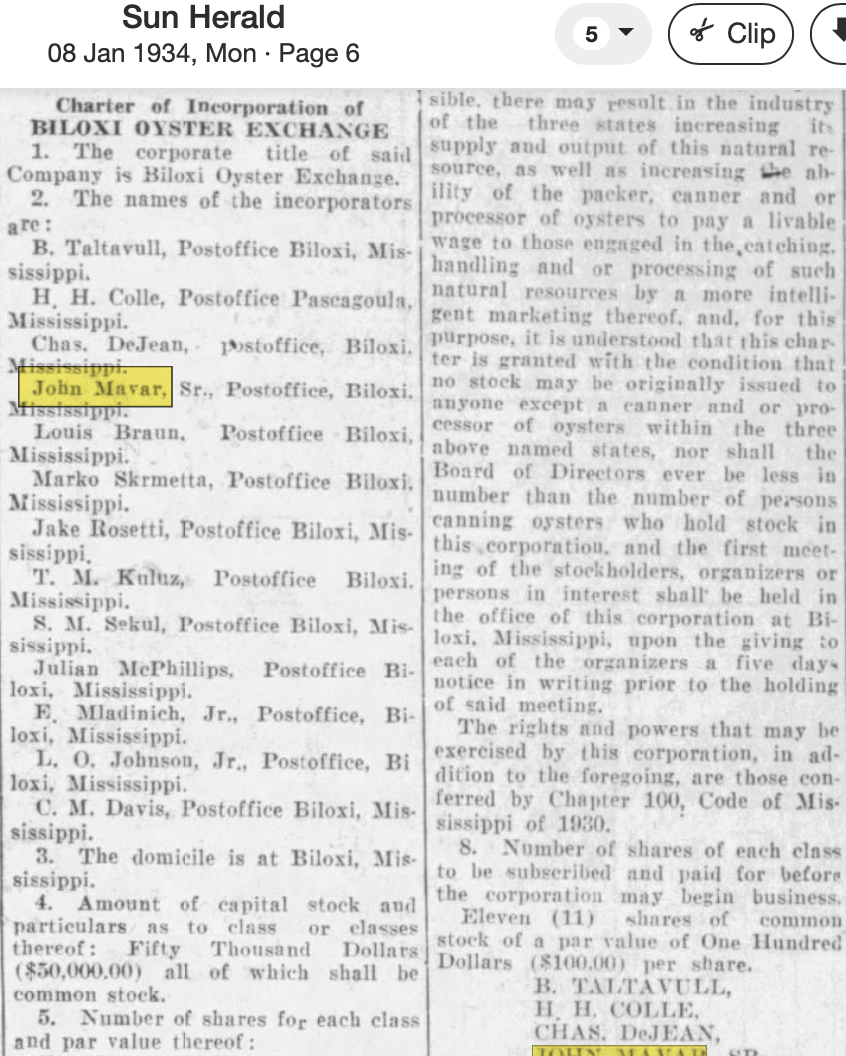
The Civil Works Administration [CWA] was established by President Franklin D. Roosevelt in November 1933 as part of the New Deal during the Great Depression. It created temporary jobs for Americans until it was disbanded in late March 1934. The CWA had a presence on the Mississippi Gulf Coast by purchasing oyster shells from seafood factories and planting them to replenish and increase production on local reefs. A list of potential bidders for this project was provided by Biloxi Mayor R. Hart Chinn, admininistrator of the oyster planting program. The list , which was posted in the USPO at Jackson, Biloxi, Pass Christian and Pascagoula, invited selected canners to bid on oyster shell sales to CWA and deliver them to Pascagoula and Pass Christian follows: BILOXI-Biloxi Canniing and Packing Company; C.B. Foster Packing Company; Braun Packing Company; Gulf Foods, Inc.; Dorgan-McPhillips Canning Company; Desporte Packing Company; Johnson Canning Company; Mississippi Coast Packing Company; Sea Coast Packing Company; Kuluz Brothers; DeJean Packing Company; Mavar Fish & Oyster Company; George H. Higgins; Moore Sales Company; and Edward Braun. PASCAGOULA: Mexican Gulf Packing Company; George H. Higgins; Edward Braun; Pelham Fish & Oyster Compnay. PASS CHRISTIAN: Dunbar-Dukate Company; George H. Higgins; Edward Braun; Gulf Foods, Inc.; and Braun Canning Company. GULFPORT: Wallace Fountain.(The Daily Herald, February 17, 1934, p. 2)
The Gulf Coast Canneries of Biloxi operated by Louis Johnson Jr. remains closed after a boycott from the fishermen's union after he rejected a 200 barrel load of spoiled oysters delivered by the Jennie Johnson to his factory. Johnson had received no oysters since this action. The Braun factory is also closed. Mr. Braun expects to move to Louisiana and Johnson is antcipating a trip to the Bayou State to insect several sites to relocate his cannery. The closing of these two factories has left 450 seafood workers unemployed. Johnson and Braun's plants packed about 60% of the shrimp at Biloxi this season. Last year, Marco Skrmetti moved the Deer Island Fish & Oyster Company to Bayou La Batre, Alabama.(The Daily Herald, April 27, 1934, p. 1)
The ice plant of the Dunbar-Dukate at Pass Christian, Mississippi began to make ice in June. The plant has not operated in several years, but the last two winters, R. Hart Chinn and Louis E. Braun of Biloxi, had leased the factory. Dunbar-Dukate had been in operation for many years at Pass Christian and when the factory was fully engaged, employed about 400 workers.(The Daily Herald, June 19, 1934, p. 1)
In 1934, Dunbar-Dukate built a new shrimp cannery at Pass Christian and did extensive repairs to its oyster cannery there. Elbert L. Dukate (1881-1943), vice-president of the company and R.R. Abbley, cannery manager. Dunbar-Dukate planned to operate here on a full-time basis.(The Daily Herald, July 16, 1934, p. 1)
In July 1934, meetings were held at Bay St. Louis for opponents and proponents of seafood factories on the beach front of Bay St. Louis. Mayor G.Y. Blaize spoke in favor of the industry locating here.(The Daily Herald, July 18, 1934, p. 1)
When the 1934 shrimp season began at Biloxi on August 15th, there were about 500 boats and 5000 seafood workers toiling for the following canneries: Biloxi Canning Company; Braun Canning Company; Gulfco Seafoods Company; DeJean Packing Company; Dorgan-McPhillips Packing Company; Mavar; Mississippi Coast; Sea Coast Packing Company; Anticich Packing Company; Mladinich Packing Company; Johnson Canning Company; C.C. Company; Dubaz Brothers; and Kuluz Brothers.(The Daily Herald, July 27, 1934, p. 1)
On July 26th, the Seacoast Packing Company opened its remodeled packing room designed to meet the requirements of the pure food and drugs administration and the recommendations of the National Cannery Association. Steve Pavlov. president; Alex Pitalo. vice president; and Steve Sekul, secretary-treasurer.(The Daily Herald, July 27, 1934, p. 1)
Dixie Fisheries Incorporated owned by Ernest Mladinich Sr. (1875-1953), Ernest Mladinich Jr. (1906-1990), and Jake? Mladinich Sr. (1902-1967) are making extensive improvements to their East Beach plant to comply with the new health inspection requirements. The work will be completed before the opening of the shrimp season.(The Daily Herald, August 2, 1934, p. 2)
Biloxi's 1st Oyster Festival was held on Labor Day, September 3rd. The event was sponsored by the Biloxi Elks Lodge and held on the grounds of the Riviera Hotel at Lameuse and Beach Boulevard. Miss Violet Magas representing Anticich Canning Company was the winner; 2nd place-Elizabeth Misko, DeJean Packing Compan; 3rd place-Josephine Tremontana, Sea Coast Packing Company. Other contestants for Oyster Queen and their sponsors were: Yvonne Blanchard, Dorgan-McPhillips; Amy Kennedy, Biloxi Canning Company; Floris Kulivan, Mavar Shrimp & Oyster Company; Evelyn Melerine, Cruso Canning Company; and Eva Talianicich, Kuluz Brothers. Leon 'Red' Strong won the oyster opening contest by shucking 119 oysters in 15 minutes. The Point Cadet tug-of-war team defeated Back Bay.(The Daily Herald, September 3, 1934 and Biloxi-D'Iberville Press, August 26, 1976)
The Seacoast Packing Company received Government Permit No. 1, which certified that their products met the requirements of the FDA. They shipped the first carload of government inspected shrimp to Chicago on 13 September. [The Daily Herald, Sptember 14, 1934]
1935
There was an extreme paucity of crabs on the Coast which required that they be brought in from St. Bernard Parish, Louisiana. This phenonmena was explained by the fact that an abundance of fresh water was reacing the Sound from flooded rivers and streams from their drainage basins. It was related that: "This is said to be the first time in history that waters of the Mississippi Sound have failed to supply the demand for crabs to the point the dealers in crabmeat found it necessary to obtain their supply from Louisiana."(The Daily Herald, April 5, 1935, p. 1)
Mississippi Seafood Commission members inspecting the oyster grounds off Pass Christian reported that the reefs were in excellent condition even though a large volume of fresh water had entered the Sound from the inundated Pearl River. Chief Inspector Louis Staehling said that there are about 25 square miles of reef in Mississippi now fecund with about 200 square miles conducive for the cultivation of oysters. Culling was the only hindrance to the development of Mississippi's oyster industry. Staehling said that the culling statues would be strictly enforced next year and the cooperation of the fishermen and factorymen is essential. The law required that not more than 5 percent of the oyster catch steamed "shall be under three inches." Commission members on the tour aboard the Alathea Vardaman were: E.H. Bacot-Pascagoula, president; Louis Hahn-Biloxi; Vinson Smith Sr.-Pass Christian; S.C. Spencer-Ocean Springs; Dr. D.H. Ward-Bay St. Louis; Dr. M.R. Mosley-Biloxi, secretary; and Louis Staehling-Biloxi, chief inspector.(The Daily Herald, April 10, 1935, p. 1)
In August, Biloxi packing plants remained idle and shrimpers were also on strike at Bayou LaBatre, Alabama. They were asking $8 per barrel for shrimp. but factory owners only offered $6.50 per barrel. The Deer Island Packing Company, a non-union shop, owned by Biloxian Marco Skrmetta, was under duress by pickets. Harold Bosarge, Frado Tillman and Ira Calloway were wounded by shot gun fire. Ten white men and 5 negroes were arrested.(The Daily Herald, August 14, 1935, p. 1)
Miss Frances Pavlov was chosen Queen of the 1st Annual Oyster Festival at the Elks Frolic on Beach Boulevard on September 2nd. Sponsors for the event were: DeJean Packing Company; Sea Coast Packing Company; Mavar Packing Company; Kuluz Brothers Packing Company; C.C. Company and W.M. 'Bill' Cruso; Braun Canning Company; Sanitary Fish & Oyster Company; Wentzell Brothers; Gallotte [sic] Brothers; and Southern Shell Packing Company(The Daily Herald, August 14, 1935, p. 1 and September 3, 1935, p. 2)
In September 1935, the Peoples' Bank of Biloxi sold the C.B. Foster and Company tract located at 224 East Back Bay to the Southern Shell Fish Company, a subsidiary of the Wesson Oil Company. The sale included: the factory; eight boats; shipyard; labor camp, which was composed of forty-nine homes; a store; and warehouse. Chester August Delacruz (1889-1964) was secretary of the C.B. Foster Packing Company from 1916 to 1931 and president until 1933 when he took over the reins of the Biloxi Oyster Exchange. In 1935, he became local manager of the Southern Shell Fish Company on Back Bay. Chester Louis Delacruz (1911-1996), his son, succeeded his as manager until his retirement in 1976.(Harrison Co., Mississippi Chancery Court Charter Bk. 16, p. 284 and The Jackson County Times, September 14, 1935, p. 1 and The Sun Herald, July 8, 1996, p. C2 and see also Harrison Co., Ms. Chancery Court Cause No. 14013, Biloxi Oyster Shell Grit Co. v. C.B. Foster Packing. Co.)
On September 1st, Gulf Coast fishermen began working under a temporary agreement with factory owners in an attempt to get $7.50 for a barrel of shrimp. The agreement continued until October 15th when the seafood industry shut down with Biloxi's 2000 boatmen and more than 500 trawlers idled. Number of packing plants closed were as follows: Bayou La Batre, Alabama-2; Biloxi-10; Ocean Springs-1; Pascagoula-2; Pass Christian-2 and Bay St. Louis-2. The strike was settled on November 4th with the fishermen getting their 50 cent increase per barrel of shrimp.(The Daily Herald, October 17, 1935, p. 1, October 18, 1935, p. 1., November 4, 1935, p. 1)
1936
Seacoast Packing Company bought the Martin Fountain Packing Company from the 1st National Bank of Biloxi.
Factory owners and fishermen agreed on the price for shrimp between $5 and $6 per barrel depending on size. Factory owners also paid $1.50 per barrel for freight and furnished ice. A $.50 increase per barrel would commence after October 1st.(The Daily Herald, April 8, 1936, p. 1)
Union officials recommended that The Gulf Coast Shrimpers' and Oystermens' Association join the American Federation of Labor. Unionist estimated that the independent labor group had about 4250 members with about 2000 more working in seafood factoies.[The Daily Herald, cotber 31, 1936, p. 1]
In late November 1936, Biloxi canneries received between 1500 and 1800 barrels of shrimp to process.(The Daily Herald, December 1, 1936, p. 5)
Biloxi Seafood Packing Company-founded by Paul Halat (1909-1977), spouse of Margaret Skrmetta, and Devoy Colbet (1920-1992). Four boats: Austrian Girl; Penguin; ?; and ?. Sold to Kuljis family.(Joyce Halat Franklin, January 2008)
[from The Daily Herald, December 10, 1936, p. 8]
1937
152,399 barrels of oysters were taken from public reefs in Mississippi in 1937.(The Daily Herald, January 3, 1940, p. 1)
1938
217,722 barrels of oysters were taken from public reefs in Mississippi in 1938.(The Daily Herald, January 3, 1940, p. 1)
1939
In June, Southern Seafoods was incorporated at Biloxi by Dominick Cvitanovich, Anthony T. Cvitanovich, Mary Trojanovich Cvitanovich, and Philomena Sercovich Cvitanovich.(The Daily Herald, June 29, 1939, p. 6)
The DeJean Packing Cokpany was placed in receivership by decree of Chancellor D.M. Russell on a petition filed by the Peoples Bank of Biloxi. Elmer Williams and Glenn L. Swetman were named recivers.[The Daily Herald, September 9, 1939, p. 2]
In late September, Biloxi’s factory proprietors faced with a surprise demand of a $1 increase per barrel of shrimp, rejected the local Union proposal, which would have created losses at the new price of $8 per barrel. About 500 fishing vessels were involved in the strike. Two raw seafood dealers, Roy Rosalis and Tony Cvitanovich, accepted the Union offer. A seafood dealer at Bay St. Louis also agreed with the new price. By 23 September, the majority of Biloxi’s large seafood factories: Anticich, Cruso Canning, Southern Shell, Roy Rosalis, John Berneski, Southern Fisheries, and Dorgan-McPhillips had accepted the new $8 per 200 pound barrel Union tender. They were joined by Marine Sea Food Products, Bay St. Louis and Kierney of Slidell.[The Daily Herald, September 21, 1939, p. 1; September 22, 1939, p. 1; and September 23, 1939, p. 1]
In November, a truck from Louisiana transporting 8000 pounds of iced, roe mullet to Bayou LaBatre, Alabama, was intercepted at Pass Christian by what was interpreted to be union sympathiesers from Biloxi. The loyal cadre emptied the truck leaving the fish on the roadside.[The Daily Herald, November 14, 1939, p. 1]
1940-1950
1940
Gulf Sea Foods was incorporated in January by Frank Johnson [1903-1963], Helen Potter Illing Johnson [1900-1954] and Edwin A. Bubier [1898-1950], resident of NOLA and native of Maine, and step-father of Helen P. Johnson.[Harrison County, Mississippi Chancery Court Chattel Bk. 69, p. 411]
The Hattie K, owned by Dewey Krohn, sank in front of his home at Cedar Lake, in late January after the bow was ripped open by ice which was deemed thick enough to skate upon. January 1940 was marked by extreme cold weather with much of the month recording days below freezing.[The Daily Herald, January 31, 1940, p. 1]
Elmer Williams and Glenn Swetman, receivers of the DeJean Packing Company in liquidation, were authorized by Chancellor D.M. Russell to borrow $40,000 from The People's Bank to liquidate and pledge certain maunfactured products as security for the loan.[The Daily Herald, January 30, 1940, p. 1]
Peter Negovetich (1869-1940) expired on February 15th. He was a trawl and net maker and is credited with inventing a system for removing the long seine from the water without going overboard.(The Daily Herald, February 16, 1940, p. 3)
Elmer Williams and Glenn Swetman, receivers of the DeJean Packing Company in liquidation, were authorized by Chancellor D.M. Russell to borrow $15,000 to continue the operations of the business.[The Daily Herald, March 30, 1940, p. 1]
The Braun Canning Company and shell crushing plant has been closed and the property leased to the Westergard Boat Works. The company moved to another location on Back Bay.[The Daily Herald, May 4, 1943, p. 2]
The 1939-1940 Mississippi oyster harvest was 755,312 barrels that were taken from Mississippi and Louisiana reefs. Mississippi reefs received 75,772 barrels of spent shells which cost 8 cents per barrel to plant.(The Daily Herld, May 7, 1940, p. 1)
Laz Quave, King Raw Stock II, and Maizie Mouton, Queen Pearl, ruled the annual Oyster Festival held in mid-May at the Slavonian Lodge.(The Daily Herald, May 13, 1940, p. 3)
[The Daily Herald, June 14, 1940, p. 1 and p. 6]
Captain Steve Rodolfich 116 Maple Street was honored with a silver loving cup for his contributions to the oyster industry by Dunbar-Dukate and the Louisiana Conservation Department for delivering the best oysters to Violet, Louisiana for the 1940 oyster season and for the discovery of oyster reefs in Lake Borgne.(The Daily Herald, June 28, 1940, p. 8)
On 1 August, Hazel Kornman Nixon sold a lot on East Howard Avenue to the Gulf Coast Shrimper's & Oystermen's Association for $1425. The parcel had a frontage of 40 feet on Howard and was 200 feet deep. The Joe Ewing, president of the Association sold this tract back to Mrs. Nixon in March 1941 for $1600.[Harrison County, Ms. Land Deed Bk. 234, p. 89 and Bk. 237, p. 456]
In August Biloxi's fishermen struck local canneries for an increase in shrimp prices from $7 per barrel to $8 per barrel. Louisiana canners were paying $6.50 per barrel and local factory owners said that they could not compete with paying fisherman thier demandsof higher prices. Estimating Biloxi losing $200,000 per week.(The Daily Herald, August 31, 1940, p. 1 and September 13, 1940, p. 1)
William Cruso (1892-1975) opened his modern new plant in September. Cost $14,000 to upgrade and employs 400 people.(The Daily Herald, September 28, 1940, p. 2)
Weems Brothers Seafood Company-founded in 1941 on Oak Street and Back Bay by Joseph Eugene Weems (1912-2005) and Charles Weems? Children of Eugene Weems and Kathryn Weems.(The Sun Herald, May 3, 2005, p. A6)
On December 10th, Max N. Tobias for $18,000 sold to the Gulf Coast Shrimpers & Oystermens Association the Burns Hotel [formerly the Kennedy Hotel] building for their meeting and social affairs. John Ewing was president of the local union which had 2000 paying Biloxi members, 150 in Pass Christian, 100 in Bay St. Louis and 75 at Ocean Springs.(Harrison Co., Mississippi Land Deed Bk. 236, p. 97 and The Daily Herald, March 4, 1941, p. 10)
1941
The Southern Seafood Exchange was organized at Biloxi on 3 January. Temporary officers named were John Mavar Jr., chaiman and W.C. Weir, secretary. The governing board was represented by: Bernard Taltavull; Elmer Williams; Tony Cvitanovich; and Roy Rosalis. The organization was formed to promote the Seafood Industry to the fullest extent of its members and to make Biloxi the seafood center of the Gulf Coast. Firms represented at the meeting were: Biloxi Canning & Packing Company; Gulco Seafood Company; Southern Seafoods, Incorporated; Southern Shell Fish Company; Union Fisheries; Gulf Fish & Oyster Company; Mavar Shrimp & Oyster Company, Ltd.; Dejean Packing Company; Quality Seafoods; Wentzell Brothes; Dubaz Brothers; Kuluz Brothers Packing Company; Seacoast Packing Company; and the C.C. Company. [The Daily Herald, January 4, 1941, p. 1]
The E.W. Illing Jr.’s Gulf City Canning Company, formerly the Ocean Springs Packing Company, closed. It had been leased to Louis G. Moore (1900-1978) of Biloxi who owned a fleet of fishing vessels and had spent time and money to get the plant in operation. Mr. Moore had difficulty getting shuckers to work in the factory. It had been closed for several years until Moore's effort to revitalize it. He had brought 600 barrels of oysters to the plant, but could get only 20-24 workers to come to work in a two day span. The local seafood workers had union affiliations and didn't care to work at Moore's plant. He had even secured an agreement with the OSHS to use its siren to notify workers that they were needed at the factory.(The Jackson County Times, February 1, 1941, p. 1 and The Daily Herald, February 3, 1941, p. 4)
On August 14th, William C, Cruso (1892-1975) representing the Biloxi packers and factory owners agreed to pay the members of the Seafood Workers Union 1 1/2 cents per pound to pick shrimp and to pay fishermen $7 per barrel of shrimp. The shrimp season had opened on August 10th.(The Daily Herald, August 14, 1941, p. 7 and August 15, 1941, p. 3)
Humphreys Canning Company, located on the west pier at Gulfport, resumed operations on September 29th. The factory had been closed fro two weeks pending the results of a tropical storm in the Gulf. At its peak operating period, the cannery employs between 100 and 200 workers.(The Daily Herald, September 20, 1941, p. 3)
1943
The following Biloxi packers atended the OPA meeting at New Orleans to discuss ceiling seafood prices: A.O. Soares and V. Santos of the Biloxi Canning Compnay; Roy Rosalis of Union Fisheries; J.E. Wentzell-Wentzell Brothers; Steve M. Sekul-Seacoast Packing Company; Mary Anticich-Anticich Packing Company; R.H. Sewell-DeJean Packing Company; Claude Coulter-Kuluz Brothers; John Mavar Jr.-Mavar Shrimp and Oyster Company; John Ewing and Jack Williams of the Gulf Coast Shrimpers and Oystermen's Association.(The Daily Herald, May 27, 1943, p. 2)
Ernest Mladinich sold Dixie Fisheries to Joe Leckich and James Williams. L.G. Moore and Matteo Stanovich have acquired Quality Seafood and V. Santos and O.A. Soares now run the Biloxi Canning Company. In early August, shrimp prices were $15 per barrel for 25 count per pound and $12 per barrel for 26 to 40 count per pound.[TDH, August 5, 1943, p. 6]
William C. Cruso (1892-1975) was building ten, small, four-room homes for the employees of his factory.(The Daily Herald, September 16, 1943, p. 8)
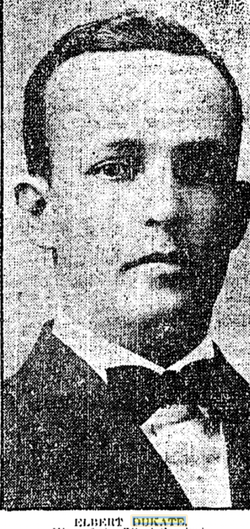
Circa 1938, Elbert Lester DuKate [1881-1943] and family relocated to New Orleans. They made their home at 313 Madison Street where he was the general manager of the Dunbar-Dukate Company, a major Gulf Coast seafood canning concern. Like his father, E.L. DuKate was an entrepreneur. In addition to managing Dunbar-Dukate, he was chairman of the board of the First National Bank of Biloxi; president of the Polar Ice Company; president of the Gulf Coast Warehouse Corporation; vice president of the New Iberia Canning Company and Alabama Canning Company at Bayou La Batre, Alabama, as well as the Pelican Lake Packing Company at Houma, Louisiana.(The Daily Herald, October 11, 1943, p. 1 and p. 8)
In October, the Gulfport Canning Company was granted a State charter. Principals of the organization were: John Evanovich (1908-1989)-1323 East Beach, Biloxi; Frank Webster, Gulfport; and D.M. Graham Jr., Gulfport. The business was situated on the city dock.(The Daily Herald, October 23, 1943, p. 7)
1944
The Victory Packing Company on Point Cadet has been reorganized and is now owned and operated by James Williams, who was a partner in the business with Louis Thornton, Joseph Leckich and John Ewing, former president of the Gulf Coast Shrimpers and Oystermen's Association. Mr. Leckich has sold his interest in the firm to Thornton and Ewing. Mr. Ewing will be president of the new company, Thornto vice-pres., and Williams, sec.-treas. Mr. Ewing and Williams will operate the plant and Mr. Thornton will be on a freight boat working for the company. Last year, James Williams and Joe Leckich acquired the plant which had been the old Dixie Fisheries. Initially, they processed raw oysters and now they plan to handle frozen shrimp, canned and raw oysters and during the summer crabs. Presently Victory has about thirty employees at the factory and are operating two freight boats. Thier new equipment consisits of conveyors, picking tables and various machinery.(The Daily Herald, September 20, 1944, p. 7)
Theodore Joseph Desporte (1885-1944), a founder of the Desporte Packing Company, expired at Biloxi on octber 30, 1944.(The Daily Herald, Ocotber 30, 1944, p. 1)
1945
In March 1945, the Corps of Engineers opened the Bonnet Carre Spillway allowing overflow waters of the Mississippi River to destroy oysters in coastal Louisiana and Mississippi. Federal authorities related that the dreaded oyster drill would be destroyed by the fresh water as well. The oyster industry opposed the opening of the spillway.(The Times-Picayune, March 27, 1945, p. 2 and The States-Time, April 23, 1945, p. 6-A)
1946
The State of Louisiana placed new restrictions on vessels shrimping in their State waters as follows: Waters lying east of a line extending south from the mouth of the East Pearl River and bounded on the south by the north shore of Bayou La Loutre and Point Chicot; and east of a line described as running from Point Chicot in a southwesterly direction to Battledore Reef, as shown on US Coast and Geodetic Survey No. 1272; thence [the description continues and is lenghty see original article]. Louisiana was acquiring two planes and four more big boats to patrol the area.{The Daily Herald, August 9, 1946, p. 1]
Ralph Duncan (1911-1987), Biloxi seafood processor and distributor, made the first air shipment of seafood from Biloxi. Four thousand pounds of frozen, fresh shrimp aboard a Chicago and Southern Airlines DC-3 was air freighted to Detroit, Michigan in mid-August. Duncan expected the flight about seven hours.(The Daily Herald, August 13, 1946, p. 1 and August 15, 1946, p. 1)
1947
In May 1947, William C. Cruso (1892-1975) of Biloxi was a witness in congressinal hearings where Representative William M. Colmer [D] of Mississippi had filed legislation seeking $3 million dollars in reimbursements from the Federal government for damages to Mississippi oysters beds when in March 1945, the Corps of Engineers opened the Bonnet Carre Spillway allowing overflow waters of the Mississippi River to change the salinity of the water in the oyster producing area of south Louisiana and coastal Mississippi killing oysters valued at over $10 million dollars.(The Advocate, May 11, 1946, p. 2-A and The Times-Picayune, May 7, 1947, p. 22)
Southern Seafoods owned by Andrew Cvitanovich (1927-2014) president, and A.T. 'Tony' Cvitanovich (1886-1964), secretary-treasurer, leased their seafood plant on Back Bay to Joseph P. Leckich (1904-1950) and Robert A. Fayard (1915-1987) on September 8, 1947. The small plant was situated north of BayView Avenue and west of the Southern Shell Fish Company factory. The lot was small and had been leased to the Cvitanovichs by the City of Biloxi and described as "being the width of Main Street", which it was very near.(Harrison Co., Mississippi Land Deed Bk. )
James B. Engle, aquatic biologist responsible for oyster surveys of Chesapeake Bay, came to Biloxi in late October to make a survey of the oyster reefs of Mississippi to determine the extent of damage to the shellfish populations from the recent September hurricane. He was to make recommendations to rehabilitate the damaged reefs. The oyster dredge, Uranus, was avaiable for the oyster survey. Meco Filipich, chief oyster inspector, will accompany Mr. Engle during his field work.(The Daily Herald, October 14, 1947, p. 1)
1947
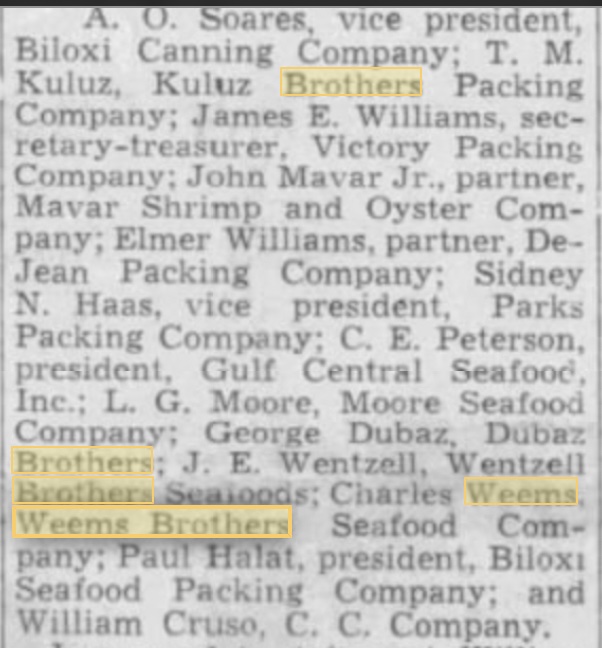
[The Daily Herald, July 24, 1947, p. 1]
September Storm very destructive to Biloxi's seafood industry.
1948
The State Senate passed a bill to appropriate $500,000 to replant oyster reefs ruined by the recent hurricane.(The Daily Herald, February 27, 1948, p. 1)
Roy Rosalis (1909-1984) planned to start a $50,000 fish sales company-The Union Fisheries Sales, Inc. It would be headquartered on Bay View Avenue at the home of the Union Fisheries. William Lasero, Boston, was to be its sales manager.(The Daily Herald, July 9, 1948, p. 7)
In 1948, Mississippi was second in the USA in the packing of oysters and shrimp. Mississippi packed 85,673 cases of oysters valued at $1,157,400 and 76,917 cases of shrimp valued at 1,095,000.(The Daily Herald, August 8, 1949, p. 8)
1949
Clell A. Dildy (1895-1991) of the Mississippi Seafood Commission urged the planting of larger oyster reefs of the Biloxi coastline.(The Daily Herald, January 14, 1949, p. 5)
1950-1960
1951
The first Coast tuna canning plant was erected at Moss Point commencing in May 1951 with the pouring of foundations for the $150,000 facility. Cecil Drake ,president and manager, expected the facility to open in late August with the capacity to process 20 tons of tuna each day.[TDH, May 26, 1951, p. 7]
The Clara Foutain, owned by Carey Galle', and Warren Galle, owned by Cecil Galle', both sank in the Chandeleur Islands in mid-December, victims of a strong northwesterer. The water pump on the Clara Fountain, which was manned by Carey Galle' and Cecil Galle', broke and the Warren Galle, with Moze Hebert and Nickie Hebert aboard, went to her aid when both vessels got caught in a winter storm and sank in shallow water. The fishermen were rescued by the Nike, a USCG cutter. (The Daily Herald, December 17, 1951, p. 1)
1952
In February, the Coast Fisheries Division of Quaker Oats completed negotiations for a lease at the Port of Pascagoula for a pilot plant to make catfood from trash fish and menhadden. Quaker planned to hire 25 people for its incipient operation at Pascagoula which was its first on the Mexican Gulf. The company markets its catfood as "Puss 'n Boots". Quaker's other catfood operations are at Lubec, Maine and Wilmington, California. Cereal mix for the processed catfood will be sent from Quaker's feed mill situated at Memphis. By late July, the pilot catfood plant was operating successfully and company management decided to increase production from 700 cases per day to 2000 cases per day. 80% of the Pascagoula port warehouse was leased for the immediate expansion and the company anticipated buying $500,00 of scrap fish from local fishermen and the plant payroll would rise to $750,000 annually.(The Daily Herald, February 8, 1952, p. 1, April 25, 1952, Section II, p. 1 and July 21, 1952, p. 1)
Braun Canning Company fire
[The Daily Herald, September 25, 1952, p. 1 with photo]
A derelict, canning factory at Main Street and Back Bay, formerly the Braun Canning Company, was destroyed by fire on 24 September. The building [150 feet by 65 feet] was owned by Madames E.A. Braun and Lomax Burdine.[The Daily Herald, September 25, 1952, p. 1 with photo]
Gulf Coast Research Laboratory biologist relates that Coast oyster beds were drought stricken.(The Daily Herald, December 23, 1952, p. 1)
1953
The oyster reefs in the Mississippi Sound were planned to be reseeded as the industry had suffered castastrophic damage resulting from a prolonged drought. High salinity water in the Sound is conducive for the growth of the oyster's enemies: the conch; a microscopic fingus, Dermocystidium; and the boring clam. Biloxi 's canneries had to import a large quantity of Louisiana oysters to continue operating.(The Daily Herald, March 2, 1953, p. 1)
1954
In late October 1954, Judge Dan M. Russell accepted the petition of Ralph Harold, Nick Mavar and Glenn L. Swetman (1901-1994) to sell in a private sale the real estate and property of the Anticich Canning and Packing Company to John Mavar Jr., Sam Mavar and Victor Mavar. The selling price was $70,000 and included the copyright brands-American Beauty and Silver Spray and the following vessels: Adriatic, Europa, Lillian; Lillian B., Louise, Mary, Baltic, Pacific, On Time, and Veronia. The sale of the Anticich Canning and Packing Company to the Mavars was effected on November 5, 1954.(Harrison Co., Mississippi Land Deed Bk. 387, p. 483 and Bk. 388, p. 346)
1955
Mayor Francis Hursey of Pass Chrisitan planned to meet with Governor Hugh White and the Seafood Commission to express his dissatisfaction with power dredging on public oyster reefs.(The Daily Herald, January 12, 1955, p. 1)
Federal Judge Sidney C. Mize set retrial of USA v. Gulf Coast Shrimpers and Oysterman's Association for late January. In February 1954, the litigation case ended in mistrial as the Federal governement attempted to prove that the local association had attempted to 'fix prices' on seafood, thereby violating the Sherman Anti-Trust Act.(The Daily Herald, January 12, 1955, p. 1)
Captain Larney B. Summerlin (1897-1955) drowned off Biloxi on January 11th, when the Katherine W. carrying about 400 barrels of oyster, capsized in the Biloxi Channel. Maynard Hall (b. 1929), his son-in-law, escaped the capsized vessel. Captain Summerlin worked for the Weems Brothers Cannery on Oak Street and Back Bay.(The Daily Herald, January 12, 1955, p. 1)
Members of Biloxi's Chamber of Commerce
[from The Daily Herald, November 23, 1955, p. 20]
Weems Seafood Company on East Bay View Avenue installed the first oyster shucking machine in a Biloxi seafood plant in late December. The machine cost about $5000 and had the capacity to shuck between 300-400 barrels of oysters each day. Irby Brothers of Gulfport and the Saucier Brothers of Biloxi manufactured some parts of the Weems' oyster shucker.(The Daily Herald, December 24, 1955, p. 10 and December 28, 1955, p. 1)
1957

[The Daily Herald, May 10, 1957, p. 5]
1958
WHOLESALE DEALERS IN MISSISSIPPI FISHERY PRODUCTS
Biloxi Canning Company; Biloxi Freezer Company; Biloxi Seafoods; C.C. Canning Company; Ray Canaan Seafoods; Crystal Ice & Freezer; DeJean Packing Company; Dubaz Brothers; R. Fournier & Son; Gollott & Canaan Seafoods; Gollott & Kinsey Seafoods; C.F. Gollott & Son; E.M. Gollott Seafoods; L.D. Seafoods Seafoods; Gulf Central Seafoods; Kuluz Brothers; Leckich & Fayard Seafoods; William Lasero Agency; Mavar Shrimp & Oyster Company; Moore Seafoods; Sea Coast Packing Compnay; Shemper's Seafoods; Southern Shell Company, Inc.; Star Sales Agency; Suarez Seafood Market; Taltavull Seafood Company; Union Fisheries Sales; Weems Brothers Seafood Company; and West Seafoods.(The Daily Herald, February 25, 1959, p. s12)
The Fishermen and Allied Workers Union went on strike against DeJean Packing Company. The disagreement was over trash fish.(The Daily Herald, May 3, 1958, p. 12)
On December 8th, the Gulf Coast Shrimpers & Oystermens Association sold the former Kennedy Hotel building on Reynoir and Railroad Streets to Steve Anthony Braun and Edward R. 'Buster' Braun for $42,000. George Williams was president of the organization with J.B. Ferrill, Howard Galle, and Albert Fountain Jr. ans Board members.(Harrison Co., Mississippi Land Deed Bk. 443, p. 212)
1959
Noel E. Balius (1905-1994), proprietor of Balius & Sons Blacksmith and Welding at 1309 East Howard Avenue celebrated his 40th year in business on August 17, 1959. During his forty years as a blacksmith, Mr. Balius says he has always worked with Floyd A. Balius (1904-1994) and Frank Mondoffie. They began making dredges when they were about 13 years of age. The Balius shop just sold 24 pairs of oyster dredges that will be used in Louisiana and Texas.(The Daily Herald, August 3, 1959, p. 23)
Henry Joseph Agregaard (1892-1959) retired seafood dealer whose shop was on Central Beach Boulevard expired at Biloxi on 2 December 1959.(The Daily Herald, December 7, 1959, p. 2)
1960-1970
1960
The Louisiana Wildlife and Fish Commission released green-dyed, shrimp into all areas of its waters. A reward of 50 cents was offered to anyone returning a 'green shrimp' to Fred Grace at their office in Biloxi.(The Daily Herald, June 17, 1960, p. 12)
In mid-June, the Mississippi Marine Conservation Commission began planting 80,000 barrels of oysters on Mississippi's reefs.(The Daily Herald, June 17, 1960, p. 21)
William Demoran, Mississippi Marine Conservation Commission biologist, was optimistic about the coming oyster harvest, but he predicted that it would not exceed that of last year's exceptional oyster season.(The Daily Herald, October 29, 1960, p. 2)
1961
The Sea Coast Company on East Beach was incorporated with 1500 shares of stock [$100 par] on September 22, 1961 by: Steve M. Sekul [1880-1966], president.; Peter C. Sekul [1892-1971]; Nicholas Cerinich [1926-2002], sec.; and Angelina Trebotich [1908-1981]. The company had been in operation for about 35 years! .[TDH, October 17, 1961, p. 7 and Harrison Co., Miss. Chattel Deed Bk. 122, p. 549]
1962
Mavar Packing Company plans to build new wharf.(The Daily Herald, June 16, 1962, p. 7)
Victory Packing Company, owned by James E. Williams (1906-1979) and Louis W. Thornton and situated just east of DeJean's Packing Company, was sold to James West in late July.(Harrison Co., Mississippi Land Deed Bk. 499, p. 483)
1963
Chester Delacruz, Charles Weems, Mike Sekul, William Cruso and the Mavar Shrimp & Oyster Company spoke about oystering in the 'good ole days' at Biloxi.(The Daily Herald, January 8, 1963, p. 2)
Four boats, Pauline T. and Lil Cruso of the Cruso Canning Company; Vixen, owned by Bill Jenkins; and the Peter Sekul of the Sea Coast Packing Company sank within two hours while dredging oysters on the Telegraph Reef off Pass Christian sank. A large pump owned by Clay Baudry of Biloxi was used to salvage the vessels within a few days. William Cruso believed that the boats were pushed over their own dredges by the swift current punturing holes in the bottom of the vessels.(The Daily herald, April 25, 1963, p. 2)
[The Daily Herald, November 23, 1963, p. 28-note these companies are members of the Biloxi Chamber of Commerce]
1964
Sea Food factories and ancillary industries operating on East Beach Boulevard were: Mavar Shrimp & Oyster Company-1114-1142 E. Beach Blvd.; Dejean Packing Company-1302-1304 E. Beach Blvd.; Moore Seafood Company-1326 E. Beach Blvd.; Moore Seafood Company warehouse-1328 E. Beach Blvd.; DeJean Packing Company shipyard-1332 E. Beach Blvd.; West Seafood-1400 E. Beach Blvd.; Dubaz Brothers-1432 E. Beach Blvd.; Kuljis Oil Dock-1501 E. Beach Blvd.; and Sea Coast Packing Company-1506 E. Beach Blvd.(1964 Biloxi City Directory-Mullin-Kille-1964, pp. 156-157)
1969
The Mississippi Marine Conservation Commission declared that the 1960 ordinance which said that boats shrimping north of the Mississippi Island chain [barrier islands] must not use more than a 50-foot trawl and a try-trawl of 12 feet [maximum length] with trawl boards no more than 18 inches, will remian in effect and that no double rigs would be permitted by shrimpers in this area.(The Daily Herald, April 19, 1969, p. 19)
John S. Mavar (1907-1973), manager of one of the Coasts largest canning plants, estimated that the loss of the seafood and related industries [ice makers, boat builders, trawl makers and machine shops] resulting from Hurricane Camille would reach $75 million. Eight or nine factories were destroyed and 3000-4000 industry workers with an annual income of $1,000,000 could expect their paychecks reduced until December and the seafood industry would not recover until June 1970. (The Times-Picayune, September 12, 1969, p. 38)
1970-1980
1973
The Dubaz Brothers Seafood Company, a Biloxi business for 54 years, was sold to Ed Hanson, a Biloxian, in the winter of 1973. The crab processing plant located at the corner of Maple Strret and Howard Avenue was sold in late November 1972. The three Dubaz brothers, Luke, George and Rudolph plan to retire after being in the seafood business since around 1918. John Dubaz, their other brother and company founder, is deceased. The Dubaz Brothers processed shrimp, oysters and crabs until Hurricane Camille destroyed the plant on East Beach Boulevard in August 1969. The company relocated and only processed crabs at the new location.(The Daily Herald, January 8, 1973)
1975
William C. Cruso (1892-1975), Biloxi canner, native of NOLA and resident of Biloxi since 1904, died on May 30, 1975. He was preceded in death by his spouse, Lillie Toche (1896-1968), who died on November 30, 1968.(The Daily Herald, November 30, 1968, p. 2 and June 1, 1975, p. A2)
Mexico threat to shrimpers.(The Times-Picayune, November 12, 1975, p. 6)
1976

[The Daily Herald, June 20, 1976, p. 2]1978
Louis G. Moore (1900-1978), Biloxi seafood operator, expired on July 26th. Moore Seafood Company was located at 1326 East Beach Boulevard on Point Cadet.
1979
James E. Williams (1906-1979), retired chief inspector of the Marine Conservation Corps, died at Biloxi, Mississippi on October 7, 1979.(The Daily Herald, October 8, 1979, p. A3)
When Biloxi was Seafood Capital of the World written by David A. Sheffield and Darnell L. Nicovich and edited by Julia Cook Guice was published by the City of Biloxi, Mississippi..
1980-1990
1982
Offshore Marine Enterprises Inc. planned to relocate its eight-boat fleet from St. Petersburg to Biloxi's Back Bay. The company planned to seek deep-water, fin fish, grouper and red snapper, on long lines.(The Sun Herald, March 28. 1982, p. A-1)
In late May, interested and enthusiastic Biloxians met at the East End Fire Station to consider organizing a Biloxi Seafood Museum. Among those present were: Jerry Bodin, Mayor Gerald Henry Blessey, Anthony V. Ragusin, Houston Gollott, Larry Dubaz, Margaret Sherry, and Tommy Gollott.(The Biloxi Press, June 2, 1982, p. 1)
The newly chartered Biloxi Seafood Museum, Incorporated elected officers in early December at the Biloxi Community Center. Jerry Bodin was elected president; Duane Diaz, vice-president; Walter Fountain, secretary; and Chevis Swetman, treasurer. Board members elected were: Carroll Kovacevich; Charles Weems; Billy Gollott; Thomas Schultz Jr.; Steve Marinovich; Gerald Cochran; Mike Chance; Joe Moran; Della McCaughn; Cheroe Arceneaux; Rosa Martin,; and Charles Bassett.The Biloxi Press, December 8, 1982, p. 1.
1989
A 200-year old citizenship law posed a problem for the approximate, 5000 Vietnamese fishermen on the Coast, if they were still aliens. The law gave the federal government the right to seize a fishing boat if the Captain was not a US citizen or if no one on the vessel could speak the English language.(The Sun Herald, October 18, 1989, p. A1)
1990-2000
2000-2010
2010-2020
2011
A surge of fresh water was pushing shrimp and killing oysters in the western Mississippi Sound due to an influx of fresh water via the Bonnet Carre Spillway into Lake Pontchartrain. Exceptionally high spring flooding on the Mississippi River system forced engineers to open both the Bonnet Carre and Morganza Spillways, control structures, up river from NOLA. Low water salinities were recorded as far east as Horn Island.(The Sun Herald, June 10, 2011, p. A1)
Freshwater from the opening of the Bonnet Carre Spillway to relieve pressure on the Mississippi River levees above NOLA pushed large amounts of fresh water into the western Mississippi Sound from Lake Ponchartrain. The oyster reefs off Pass Christian were particularly in jeopardy.(The Sun Herald, June 21, 2011, p. A1)
NOAA blames shrimpers are to blame for almost 1000 sea turtle deaths since the BP oil spill has unleashed a fury of comments in two languages.(The Sun Herald, July 14, 2011, p. A2)
Red Snapper over fished in the Gulf of Mexico according to NOAA's annual report.(The Sun Herald, July 15, 2011, p. A2)
Vietnamese shrimpers are no happier than others about NOAA allegations that they are not using turtle excluder devices [TEDS] properly and endangering and destroying the turtle population in the Gulf of Mexico. Most of the dead turtles are young Kemp Ridley turtles that are considered an endangered species.(The Sun Herald, July 27, 2011, p. A2)
Oysters dry up-hope that Texas could make up for oyster losses in Louisiana and Mississippi in 2011 were derailed by the extended drought in the Lone Star State which caused excessively high water salinities which is conducive for predators and diseases-both deliterious to the oyster population.(The Sun Herald, Augut 1, 2011, p. A9)
Not a good year for Gulf Coast shrimp industry.(The Sun Herald, August 6, 2011, p. A4)
NOAA Fisheries has decided not to impose emergency measures on the shrimping industry because their data shows that an unusually high number of sea turtles were found dead in April, a month before the shrimp season began.(The Sun Herald, August 12, 2011, p. A1)
Shrimpers, turtles both should thrive in our Gulf Waters-an editorial.(The Sun Herald, August 18, 2011, p. C2)
Vietnamese community scattered after Katrina.(The Sun Herald, August 25, 2011, p. A1)
Oyster season shuts down after 5 days.(The Sun Herald, October 28, 2011, p. A1)
Steve Crockett of Grand Bay, Alabama grows top-shelf, high quality, boutique oysters.(The Sun Herald, December 5, 2011, p. A5)
2013
Shrimp processors seek help to slow imports.(The Sun Herald, january 16, 2013, p. A1)
Paul Delcambre Sr. (1926-2013), native of Choate, Vermilion Parish, Louisiana and Biloxi resident since 1946, expired at Biloxi on June 6th. Delcambre was owner of Del's Seaway Shrimp & Oyster Company and Seaway Freezing Company. He was president of the local American Shrimp Processors and Canners Association and a member of the Mississippi Restaurant Association.(The Sun Herald, June 11, 2013, p. A7)
2014